Filmed in New York City and New Jersey between April and September 2025. Small changes made to the film, July 28, 2026.
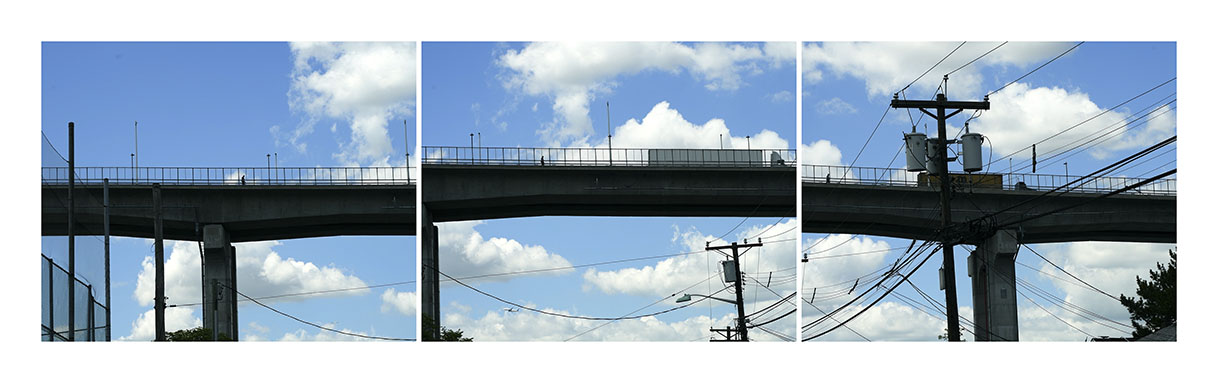
While this film is finished save for a few possible final adjustments, it is not going to be posted in full for quite some time. The 50 4K films I have made up until now range from one to fifteen minutes; this one is 76. At least as of now I care about it more than anything else I have ever made, or written. Therefore, I especially want it to be seen correctly, which is to say in high quality 4K projection on a reasonably large screen, and will do what I can to seek public showings. My attempts to do so with my existing films have failed, so this attempt may fail too, but at least I will try. You can see the first three minutes of the film here. (Airplanes are far more present here than in most of the film.)
The film focuses on thirteen different bridges in New York City, two of which are also in New Jersey. "Focuses on" can include images taken from very near the bridge but which do not show it; very occasionally another bridge is shown instead. The thirteen bridges are accompanied by two "metaphorical" bridges, airplane flights from Chicago, where I live, to New York, two of the four trips I made in 2025 to shoot this film. In the choice of bridges, as in the compositions and editing and rhythms of nearly all my films, this film strives for a certain expansiveness, so that when one of my friends who also loves my work spoke of feeling a connection to Rossellini, it made me very happy.
The principal bridges, a "cast list" really, in the order of their initial "apperances" in the film, as a grid, or as a list:
Each of the fourteen images linked to above is a still from the film. You can scroll through them all by clicking on the first. The selection of these stills is not representative, in that I chose images that showed as much of the bridge structures as possible from the images I used in this work. The great majority of bridge images used show less of the whole bridge. Further, I "count" as images of a particular bridge images taken from the span itself, or from nearby, which do not even show any of the actual bridge. New York City being what it is, many other bridges are also visible. The order of this list of bridges is not "in order of appearance," but rather in the order of appearance of the section in which that bridge is dominant. In the structure of the film, there are many images of each bridge prior to the section in which it is dominant. In fact, a few images which I consider associated with a bridge are entirely of a different bridge, if photographed near the associated bridge. Because many bridge images do not even show the related bridge, it will be difficult to tell where one section ends and another begins, and the effect that results from the bridges' interweaving is intentional. I hope that the result is a feeling of endless, onrushing flow rather than an inventory of specific bridges. I have used official bridge names wherever they exist, with the exception of the Queensboro Bridge, whose relatively new and longer official name is not in very common use. A search for any of the bridge names along with "NYC" should tell you where that bridge is located.
By definition, a bridge connects two different parts of our planet, areas that would be more difficult to travel between without the bridge. If one wants to imagine that this function of bridges informs my film both aesthetically and ethically, serving as well as an inspiration for my editing choices, one would be correct.
This film is organized into 14 sections, each of similar length, each focusing on one of the 13 bridges or, in the first, on one of two different airplane flights from Chicago, where I live, to New York. These trips were two of the four I made in 2025 to shoot this film. Four of the bridges are pedestrian-only; five are small pedestrian and vehicle bridges; four are larger than the other nine. I limited myself to bridges that one can walk over, both for the aesthetic reason of not wanting to film only from a car and also for ethical reasons, as I consider cars-only bridges something of an ecological, and hence moral, abomination. Each of New York City’s five boroughs is shown through at least one bridge situated entirely within its boundaries, and every borough is also represented by at least part of one other bridge. With the exception of two bridges that span the East River, the 59th Street Bridge and the 103rd Street Footbridge, each bridge crosses a different body of water, so that 12 different bodies of water are represented. If one detects a striving for various kinds of inclusiveness, one would be correct.
I have tried, within reason, to treat many things equally in all my films, from stones to weeds to trees to buildings to animals to waters to the sky, also allowing myself a few biases. One would be a degree of anti-anthropocentrism; you will see that individual humans are not at the center here, nor in the great majority of my films. Another is a preference for motorless bicycles over motorized vehicles, so that my portrayal of a city, in this film and in some others, will give the impression that there are more bicycles on the street than are actually present. Nature is also often shown as more present than it actually is. This film, ostensibly about bridges, has aspects of the "city symphony" genre, but also tries to find in the New York area a synecdoche, however limited in its specifics, for much of the world. Behind that impulse is the desire to encouragement myself, and others, to think expansively, never to be restricted to a single object or person, to always be seeking widening contexts for every object. Along these lines, please also see my Statement 11.
This film is dedicated to the many people who have helped me over seven decades with friendship and care. Some appeared in my photographic art works or films; some aided in my photographing and filming in different parts of the world; all offered heartfelt encouragement in different ways. A few helped me far beyond reason in my bleakest years, when I was close to the edge — saving my life. Among these: Pedro Accioly, Gabriel Almeida, Bruno Andrade, Jack Angstreich, Steve Anker, Katherine Antonova, Julian Antos, Tatsu Aoki, Jake Barningham, Christopher Becks, John Belton, Kian Bergstrom, Hisham Bizri, Amy Bodman, Marilyn Brakhage, the late Stan Brakhage, Mimi Brav, Mikita Brottman, the late Arthur Camper, Cathy Camper, the late Dorothy Camper, Chris Camper, Francie Camper, the late Frederic Camper, Jennifer Camper, the late Lorraine Camper, Sheri Camper, Kyle Canterbury, Edo Choi, Peter Coonradt, Gail Currey, Robert Edelstein, Amy Vogel Eyny, Mina Eyny, Yaniv Eyny, Jesse Farrell, Greg Ford, Patrick Friel, Brian L. Frye, Ernie Gehr, Roy Gould, David Grosz, Tom Gunning, Erin Hagood, Jonathan Hale, Felipe Herba, Anastasia Hischier, Arabella Hischier, Brian Hischier, Miles Hischier, Tim Hunter, Arnold Isenberg, Nora Jacobson, Paul Kaiser, the late Karen Keane, Liam Kenny, Lewis Klahr, Sasha Kleinbart, Peter Kubelka, the late David Laing, Devin Leong, Marjorie Mann, Deborah Meehan, the late Jonas Mekas, Bruce Melman, Yoel Meranda, Jack Miller, Jennifer Millstone, Danny Mintz, Penny Mintz, Tommy Mintz, Richard Modiano, Herb Molner, Paula Molner, Russell Moore, Harvey Nosowitz, Brian O'Connell, Joshua Peinado, Richard Peña, Becky Pierce, Mike Prokosch, Jim Rembar, Justin Remes, Andrew Reichel, Michael Reiskind, Jonathan Rosenbaum, Martin Rubin, John Sanders, Mrs. Seeley, Jack Seibert, Giovanni Silveira, the late Eric Sherman, Troy Sherman, the late P. Adams Sitney, the late Shirley Camper Soman, the late Warren Sonbert, Craig Sterritt, David Sterritt, Jeremy Sterritt, Scott Trotter, Tanya van Sant, Alexander Varouxakis Thomas, Kyle Westphal, Amanda Williams, the late Kirk Winslow, and Monika Wulfers.
COMMENTS FROM FRIENDS
I have let a few trusted friends view the complete film. One friend of 35 years, Hisham Bizri, really loved it. After his first viewing, he wrote me
Watching everyday imagery reminded me of how film has the unique capacity to capture the visual residue of reality, those moments that fall between narrative plots, where life reveals its texture. You’ve caught precisely those fragments.
By keeping the film silent, you force us to “listen" visually, much like Brakhage did. The city stops being a backdrop or a setting and becomes a pure rhythm of light, movement, structure, a thousand prayers. There’s a wonderful tension in how you take mundane, daily urban life and, through edit and light, elevate it into something deeply poetic and structural. The "bridges" feel both literal and metaphoric — connecting moments, spaces, and forms across the city without ever needing words to explain themselves. Hart Crane would have loved it.
Thank you for making this. It’s a masterpiece of faith.
I replied, with great appreciation, and I hope a bit of humor, "As a person who claims to be an atheist, I especially liked 'a thousand prayers.' The film has 490 shots, and I'd like to think that on average each shot has a bit more than two prayers!" Hisham then replied
I love love the math of 490 shots translating into over a thousand visual prayers.
andTo watch Interactions 36: Bridges is to experience New York purged of noise and restored to pure form, light, and duration. By paring away sound and story, Camper turns the 490 fragments of everyday urban life into a kinetic liturgy. It carries the rigorous spirit of Brakhage, but with a quiet, generous humanism that belongs entirely to Camper. It proves that cinema doesn't need to invent fantasy to reach the transcendent. It only needs to look closely enough at what is already here — with faith.
Another close friend, whom I will call "K," responded after viewing it:
Wow. Tremendous. Great. Last shot is amazing, from the image itself, the downward flow, to its extended duration. It should be a favorite among fc fans. For no logical reason I was skeptical before viewing it. Just because you announced it as special, and the fact that it was so much longer than the others, somehow made me dubious. That's happened before. And then I watched it. And ... OMG! I was constantly in suspense as to what the next shot would be, how it would interconnect with what preceded it and what would follow. I loved the unity of it all, the bridges seeming to me not so much leading from and to but rather between. Bridges as framing within the compositions, and the editing framing a world view, a flow that seemed at times to embrace all life, from the blades of grass to the man-made industrial sites, the bodies of water, the roadways. Loved all those shots of people (and sometimes ducks) with their images reflected in the water. The static images with cars whooshing past the frame, immersing the viewer more deeply in the sense of being there. Many memorable shots, but at the moment I think of the single shot with the most camera movements, panning up, across, down, back again, etc. And the still shot looking down on the line of waves coming to shore. The shots from within the moving plane (descending early on, the shaking towards the end) and the selection of clouds. Each having its own importance and impact but also crucially 'interacting' with the shots around it.