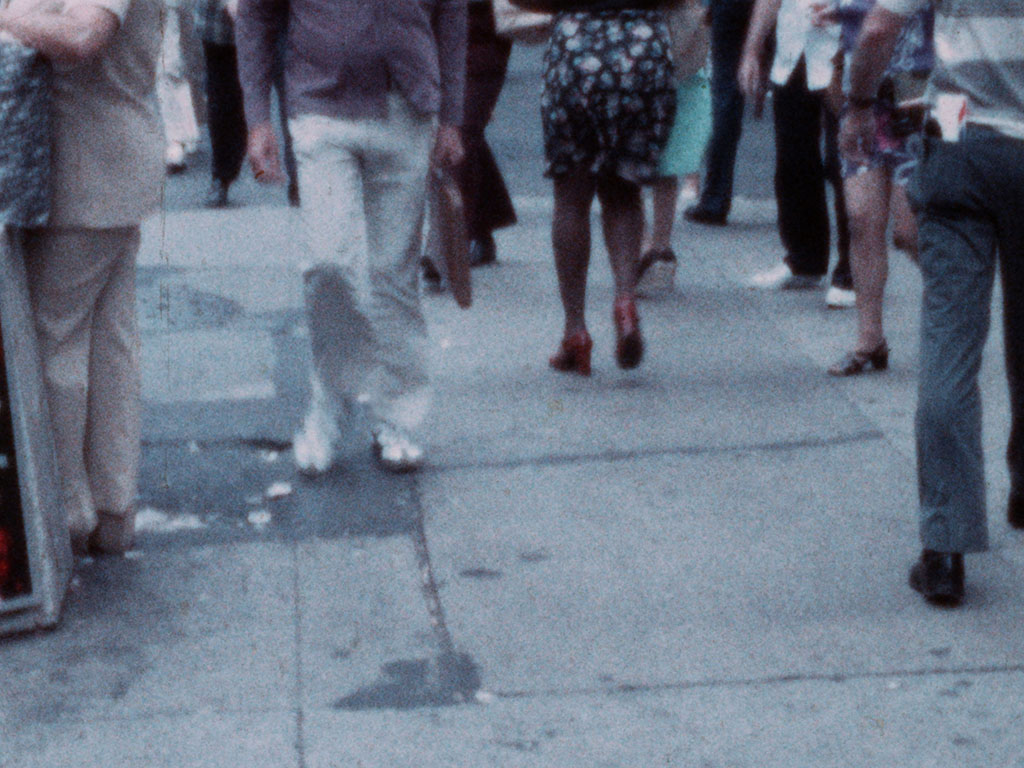
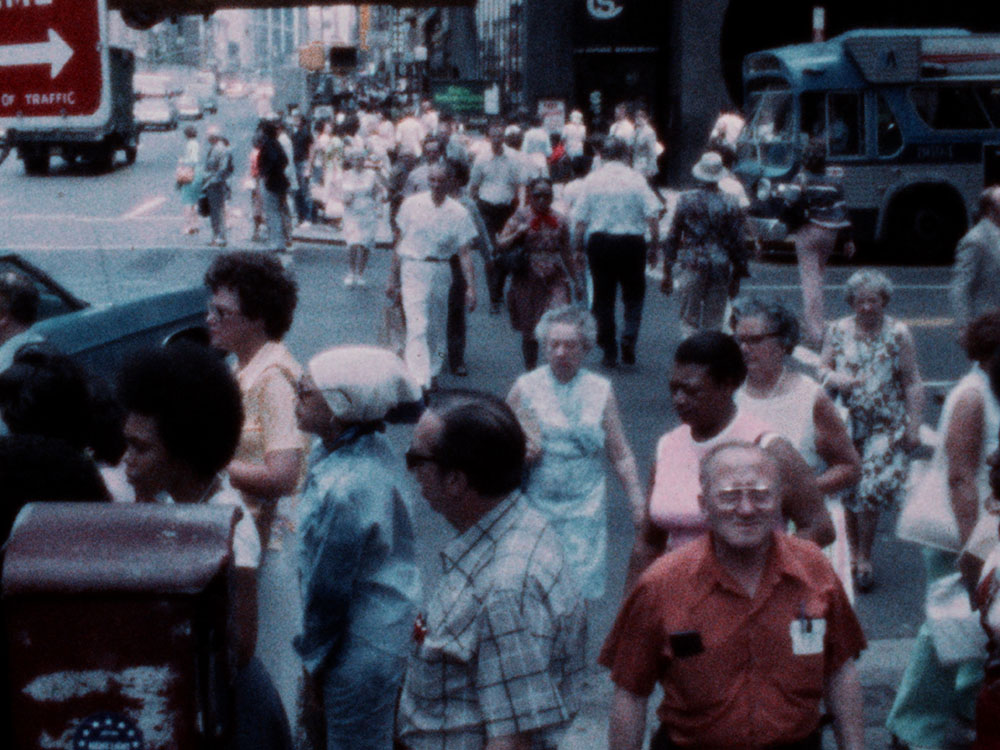
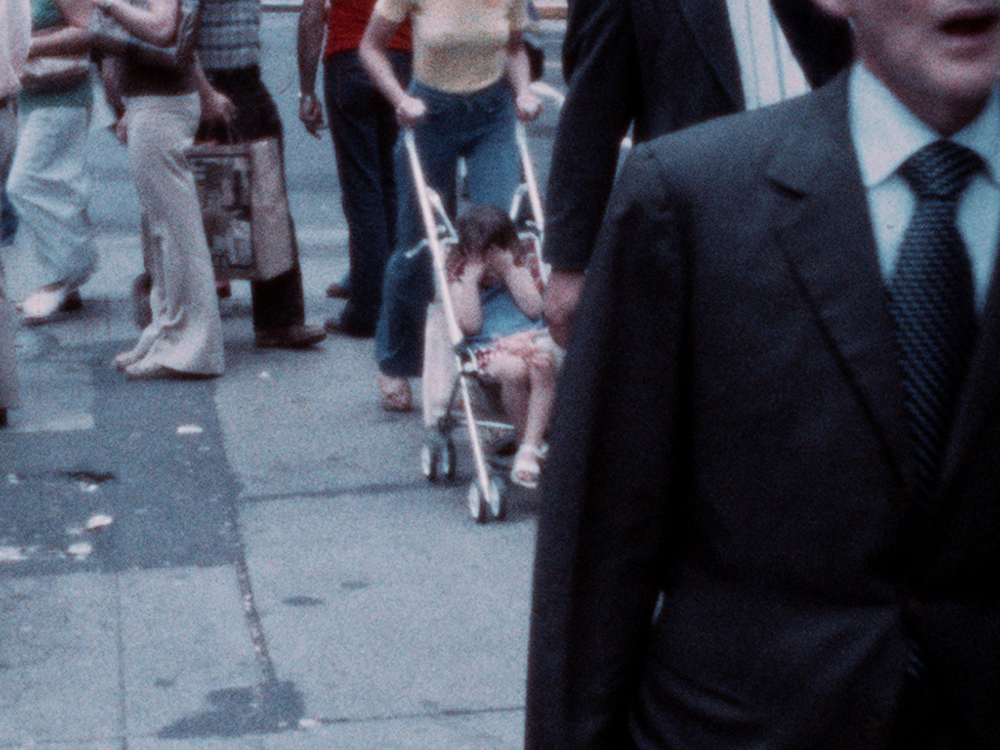
Stills from Suicide Note, Section 1. For all the images on this page and on a related page linked to below. clicking on an image will bring up a larger version. Use your browser's back button to return.
Film by Fred Camper, 1976-84, c. 95 minutes, silent, super-8 original at 18fps, currently being restored to 16mm.
This film was previously known as SN, but the title from my first conception of the film was always intended to be Suicide Note, which will now be its permanent title. After one usage of the full title in writing, I don't mind SN, in the same way one might begin to write on The Man Who Shot Liberty Valence and then sometimes switch to Liberty Valance.
View three minutes of very brief excerpts from Sections 1, 2, 4, 7, and 9.
This film, as just restored by the Chicago Film Society, will have its world premiere in October, 2026 with four different screenings at the New York Film Festival. I will be present for two of them. See the prior Festival length for dates, times, and venues in New York. The next showing will be on November 20, 2026, at 7:00 PM, presented by the Chicago Film Society at the Logan Center of the University of Chicago. I will be present to introduce the film and answer questions.
The comment below was written by Chicago curator and professor Patrick Friel in 2008, for a showing of the film at the gallery mentioned below. At the time I had no prints, and was showing edited original and edited workprints in super-8 on separate reels, with time needed for threading up each reel, which accounts for the longer estimated running time. My description follows below:
As a complement to his current show at Caro d'Offay Gallery (which has been extended a day to August 2), local film and art writer and artist Fred Camper screens his legendary (in some circles) nearly-unseen (this is only its second public screening ever) silent Super-8mm film SN (1976-84). Comprised of ten sections, one of which consists of three short reels randomly selected from a possible sixteen, Camper's film is an unsettling, hermetic work that continually pushes in on itself, a "closing down" of options (as Camper puts it) that force the viewer to consider the formal elements of the film: editing rhythm, camera movement, and, most importantly, the tension created by changing spatial configurations and the play between depth and shallowness in the image, both within each section and among the individual sections. A striking example comes late, in the longest reel: as Camper pans across the New York City skyline from different buildings the initial depth one sees collapses and flattens, becoming a near-blur and forcing attention away from the "subject" to the flatness of the screen itself. It is an encapsulation of the kind of re-focusing and re-seeing that Camper is attempting to engage his audience in throughout. In this respect, it shares a similar agenda as his current art making. SN is not an easy film and perhaps not one for the casual viewer but, even if one does not understand it completely, there are magical moments and rewards for those willing to really look. (1976-84, 105 min, Super-8mm). Camper will also be giving a just-scheduled gallery talk at 4pm on Saturday, the final day of his exhibition.
My own comments: This film attempts to construct three imaginary suicide notes: for my stepfather, who left no note when he jumped out a window to his death in 1975; for myself, not from planning to do the act but thinking about my own versions of the impulse; for our species, which even in 1976 seemed to be intentionally speeding towards its own self-destruction, just as Christopher Maclaine in his amazing 1953 film The End referred to "the grand suicide of the human race."
I came to understand suicide, in the traumatic months following my stepfather's jump, as a failure of the self. This is why the majority of suicides do not leave notes; they do not feel present enough to do so. The ones who do leave notes often write in strangely passive language: "There must be something fine for you. Love, Bill." The ultimate such "note" was the envelope left on the garage floor in a "carbon monoxide" suicide. It was marked, "To be opened only in the event of my death." It was unsealed. It was also empty. A completely failed self cannot even compose a farewell note. The active participant in the world, by contrast, can speak not only of the self, but of experiences that can expand the limits of that self.Our consumer culture, by contrast, encourages extreme passivity. We sit in our well-arranged rooms; we view wwindow displays; we stand in front of crowds of people of which we are not a part; we relax in front of our screens, fireworks shows, cityscapes, even art exhibitions, with only minimal degrees of interaction. One has only to observe the movements of many museum visitors who never stop walking, never linger to look at an art work with care, for confirmation. We may become involved enough to perceive some degree of beauty, which is also akin to creating it in the mind's eye, but only rarely do we absorb the transformative complexity of the best art by stepping outside our limited selves and into the artist's vision, following the original meaning of "ecstasy," to stand out of one's self. How often do we creatively respond to an art work, let alone construct a world of our own. Actually writing one's own suicide note, and then stepping beyond it to see and write differently and thereby live more fully, is rarer than one might hope, but that was one of my goals.
The idea for this film came to me in the spring of 1976. I had been helping a friend who was making a super-8 film for which he needed two cameras filming simultaneously, and so I had borrowed a camera and shot in super-8 for the first time. My previous experience had been mostly in 16mm. Super-8 felt, and looked, completely different. I had the idea that while 16mm could create some semblance of realistic illusion, super-8, with the more limited presence of its smaller and dimmer image, was closer to writing notes in a journal or diary. I found myself thinking of Rainer Maria Rilke's The Notebooks of Malte Laurids Brigge. Also, I was still haunted by my stepfather's suicide a year earlier. His leap was from the window of his and my mother's fifteenth floor apartment, in the Manhattan building I had grown up in. I was still haunted a year after the event, and, I might add, am still haunted today; in many cases of suicide, the survivors never fully recover. What else could I have done?
is the question that never stops asking itself. These two threads came together in a moment, while riding on a bus, in the idea of a film titled Suicide Note
. Unlike in all my work before or since, it was the title that generated the work.
I immediately understood that it would not be very nice for my friends and family members to hear that I was going to be working for some years on a film titled Suicide Note,
so to protect them, and avoid the inevitable explanations and reassurances that would be required, I called it SN, the actual title to be revealed only on its completion, and then proceeded to lie in always saying that those two letters did not stand for anything. As the restoration process began, and public showings loomed, I began calling it by its proper title again, and learned each time I did so as I observed my reaction to those two words that I had been using SN
partly for my own protection.
The film consists of a series of sections, each depicting a different subject, different kinds of experiences, with the beauty sought and felt also undercut by the central failure of the film's implied observer-protagonist to be a fully active presence in the world. Instead, things are seen as if from behind a window, and as that position becomes a self-imposed prison, it can suggest to the observer a breaking out, to pass through that window, to jump, and therefore to die.
Suicide Note was originally going to be far more massive, with multiple sections selected at random for each showing — what is now the first section was to be one of six, mostly of other crowds in other locales. However, the film as completed does read as a coherent work, its ending certainly an ending.
Crowds on the streets, the carefully arranged objects in a living room, the objects on display in a store window, a fireworks display, the view of a city from a skyscraper, are all included as examples of the passive observer's travels. I hope it is evident from the film's compositions, camera movements, and editing that these views are seen as partly successful attempts to render the seen world as poetry, or music. But in the world of this film, our present culture wins out in the end, with our dominant, highly invasive species dedicated to occupying space, filling it with human stuff.
The fireworks that take over the sky are preceded by fingers pointing upward in anticipation of the
show,
as if the empty sky were a movie screen about to be filled with imagery, one of many similar moments in this film. The passive observer, like the potential suicide, observing scenes as if from behind the glass, with it seeming at times that the only possible escape is to fall through the glass to death. Along the way, it is my hope that the film's observer finds much beauty even from a certain distance. Insofar as the cinema image is like a window, jumping out a window is the equivalent of falling into the image — as Scottie Ferguson does when he dives into San Francisco Bay in Alfred Hitchcock's Vertigo, leading to the catastrophes that follow. In this sense Suicide Note constitutes a critique of the passivity that can result from consumerism; note the absence of unmodified nature in my suicide film. My own love of real wilderness leads me to horror at the ways we endeavor to turn the planet of which we are only the partial and very recent inheritors into images of ourselves.
That the entire film is silent is perhaps a reflection of the influence of Stan Brakhage, who correctly argued in defense of his own silent filmmaking that the rhythm of a sound track always dominates the rhythms of imagery. Silence is also a fine, arguably much-needed, response to the sensory overload of a culture that endeavors to occupy our brains, destroying thinking.
The ten sections of this film do not have formal titles, but they can be referred to by the order in which they are to be shown. 1, 3, 4, 6, 7, and 10 were filmed in 1976, when I still lived in Manhattan; I moved to Chicago in August of 1976. 2, 5, and 9 were filmed on trips to New York a few years after moving away. Some of the 16 "shorts" that make up section 8 were filmed in or near New York before I moved; others a few years after. Four were filmed in Chicago, six in New York City, and six in other parts of the US.
Each section, with the exception of the individual "shorts" of Section 8, strives to create the contradictory complexity central to this film between the beauty sought but never fully absorbed or mastered, thus also creating both active and passive relationships between filmmaker and subject, and observer and film. The 4K films I began making fifty years later, which now fall into four different groups and are now fifty-one in number, have the opposite intent: the implied viewer is meant to be interacting with the encircling world with ever-deepening perceptions. The most extreme such contrast could be seen by first viewing Suicide Note, followed by the answer, even refutation, offered in Interactions 36: Bridges, 75 minutes and silent. In the latter, New York area bridges are seen from almost every possible angle, never from a drone, though a few images were taken from one of two flights from Chicago to New York for filming. Otherwise the perspective is that of a pedestrian in an almost-dizzying variety of positions: distant from the bridge, closer, below it, on the span itself, looking out at the world from the bridge without seeing any of its structure, returning to looking at parts of its structure from still more angles. The active variations here, as in all of the other Interactions and works in the other three groups, answer the passivity of the earlier film by showing the implied viewer not powerless before a world that can only be entered by jumping in, but rather attempting to dance with all its parts.
Both Suicide Note and the recent work live and breathe primarily in the subtleties of composition, framing, movements, degrees of spatial depth, color, texture, editing and editing rhythms.
1 Herald Square, Sixth Avenue just south of 34th Street (See three stills at the top of the page)
This location was chosen for maximum crowd density. People move in all directions, each with different destinations and intents, navigating spaces almost as if oblivious to each other. I saw breaks, clashes, a hint of horror. Near the end two little children are seen, one being led by hand crying and another in a stroller covering her eyes. As is often the case with children, they are the ones who can most honestly see the truth of the environment they are in.
2 The living room
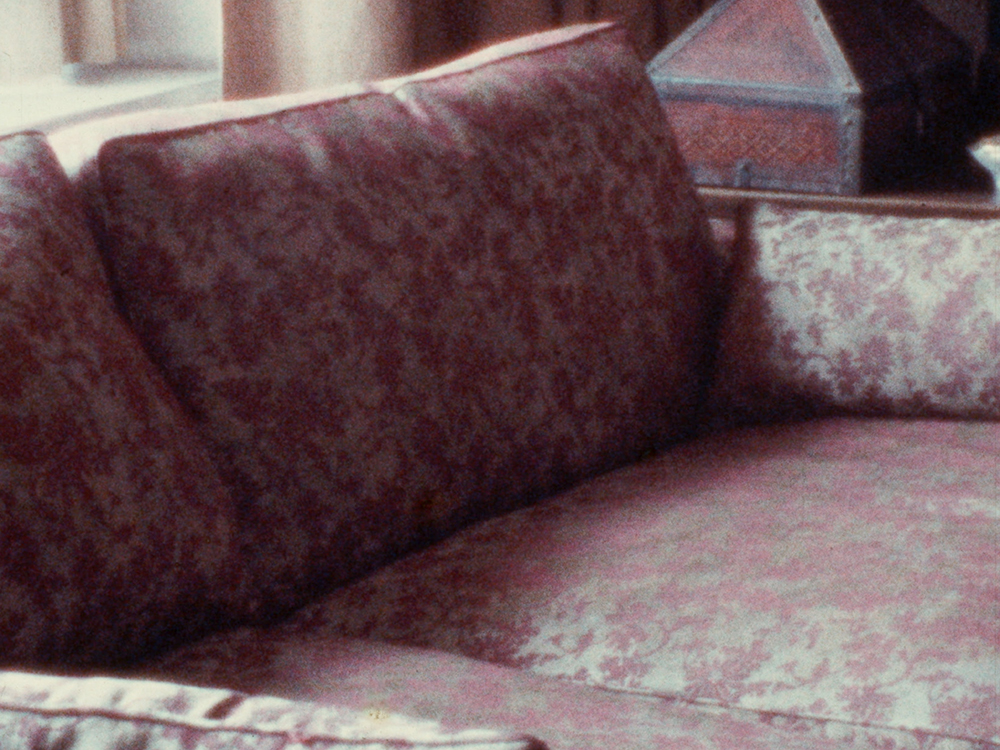
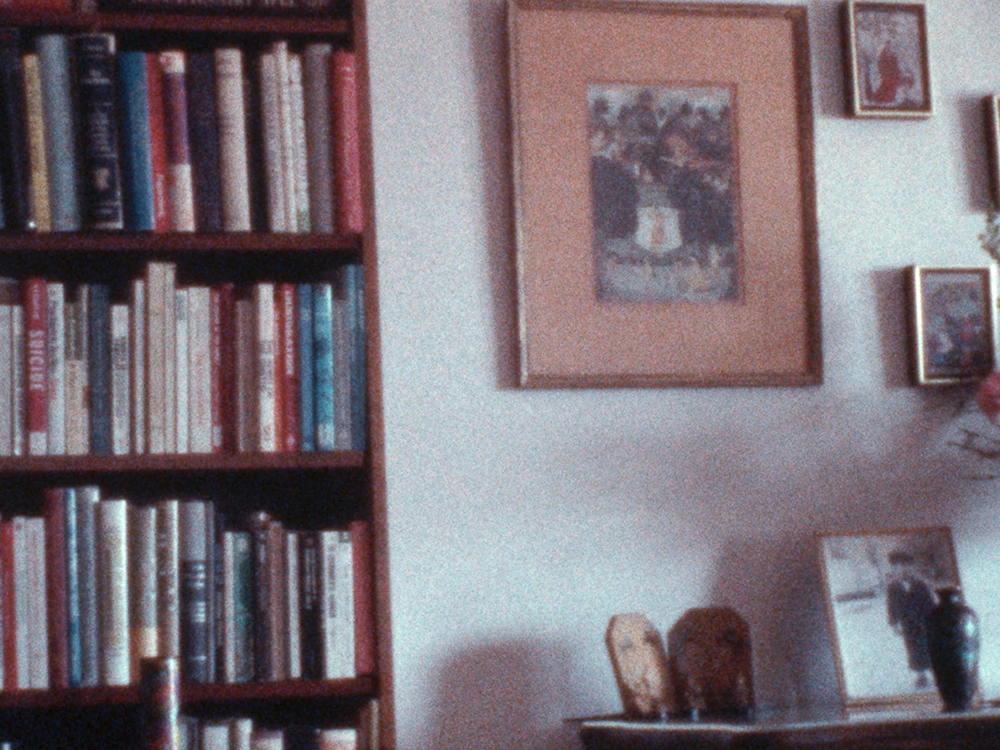
This shows the living room of the 15th floor apartment of my mother and stepfather. The windows offered a view, not shown anywhere in this film, of West 77th Street and the American Museum of Natural History. It is into that view that, from an adjacent room, he jumped.
I made three attempts to film this room, all on trips back to New York after having moved, before I succeeded. In the first two I made the mistake of thinking that the décor itself could do the work, and just moved the camera around elaborately in the manner of the mounted camera of Michael Snow's La Région Centrale. The results failed to convey much of anything. In the third attempt I tried to compose and film in response to everything in front of the lens, bringing caresses to the sensuous beauties of the surfaces of the couch, the walls, even the variety of colors in the books. The room itself was arranged with sensitivity and care. In fact, the night before the third, sucessful, filming, my mother had had a small party, and I awoke to find half empty glasses and cigarette butts. Just as I started to film, she awakened, saw that I was going to film again, and took some time to clean up, so that the room reflected her intentions and sensibilities. I saw it, however, as also stifling, excluding human life, the only movement occurring inside the small glass container that fills the final shot. Just before that, the light streaming in from the window is seen but with the camera stopping short of the window. The other exit point, a large opening opposite the window, is also not shown, creating the illusion that the room is self-enclosed, its lack of movement seemingly deadly. Not long before shooting this film, I viewed Marjorie Keller's film that presented the objects in her family's home, Objection, and it was doubtless an influence.
3 Middletown, Connecticut
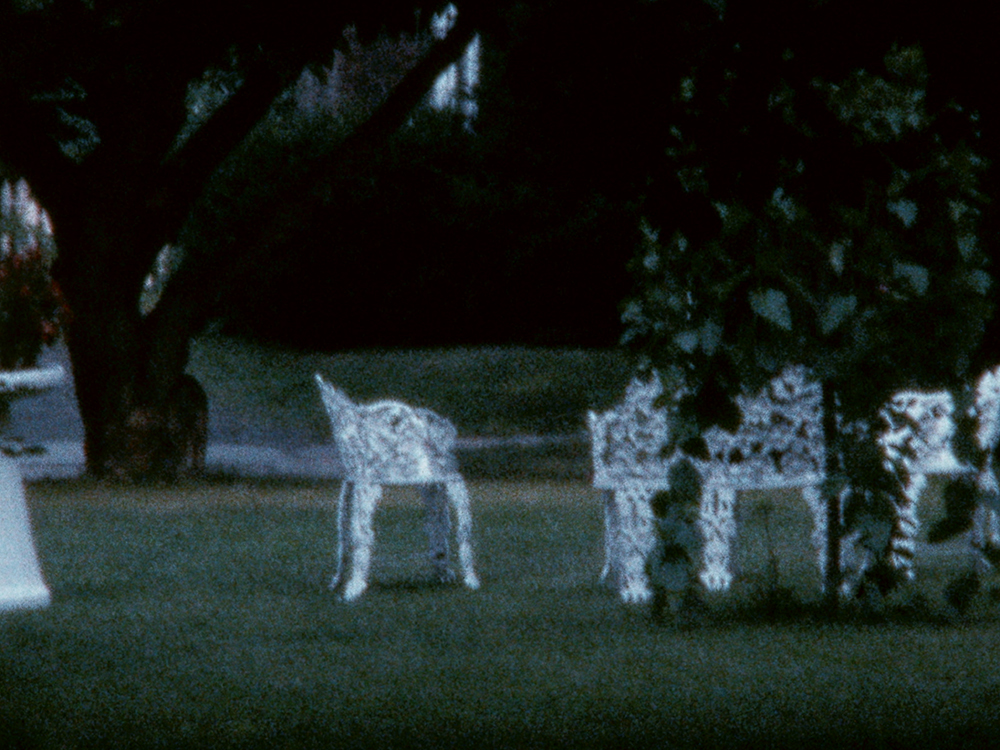
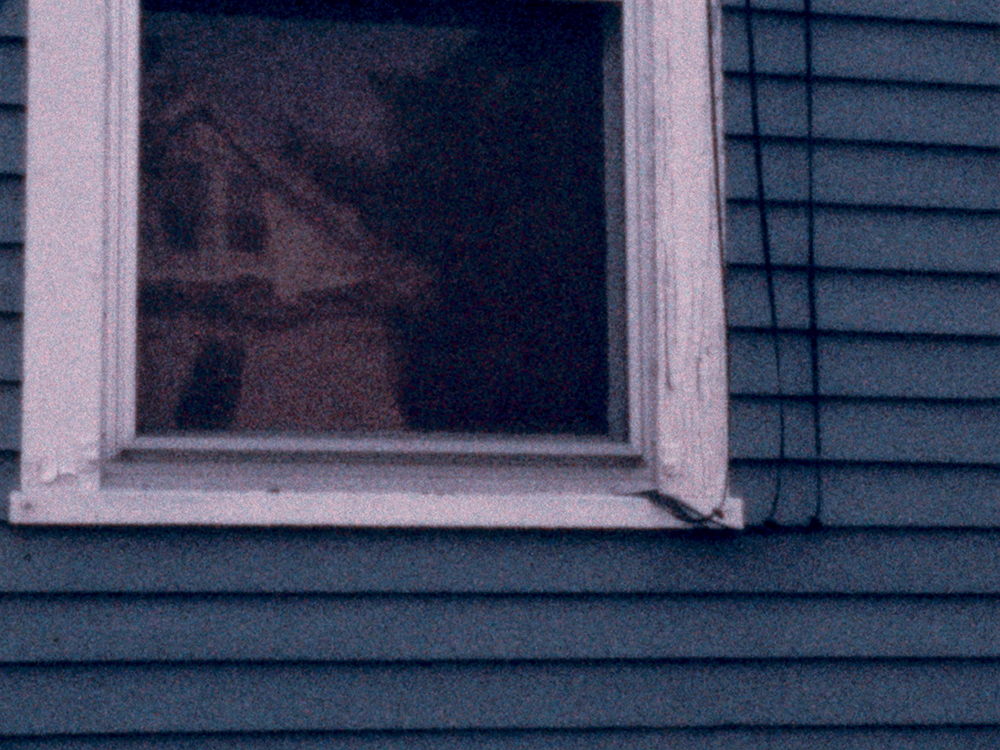
Unlike the first two sections, the filming of which was thought through in advance, this was conceived in an instant in a locale I had not visited before, when the townscape seemed to suddenly break into fragments, some a bit frightening to me: isolated benches, lawn furniture, swaths of light, peaks of roofs. In this fragment of a small Connecticut city, I saw hints of horror. Stan Brakhage's film Fire of Waters, which I have loved since first seeing it in 1965, was doubtless an influence. A theme that threads throughout Suicide Note, that of the isolated observer, enchanted by views and trying to make sense of things, is evident here, and the result is neither complete success nor complete failure. This is the only one of the nine full sections that was not shot in New York City, though my intention had I continued working was to include much more of the US.
4 Herald Square, again
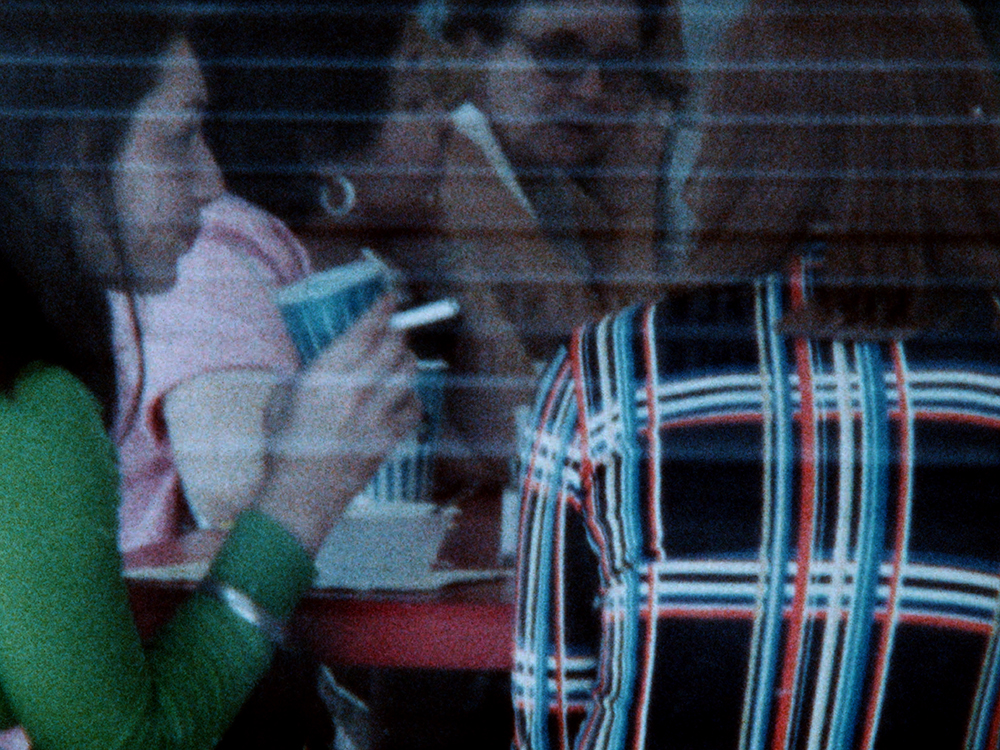
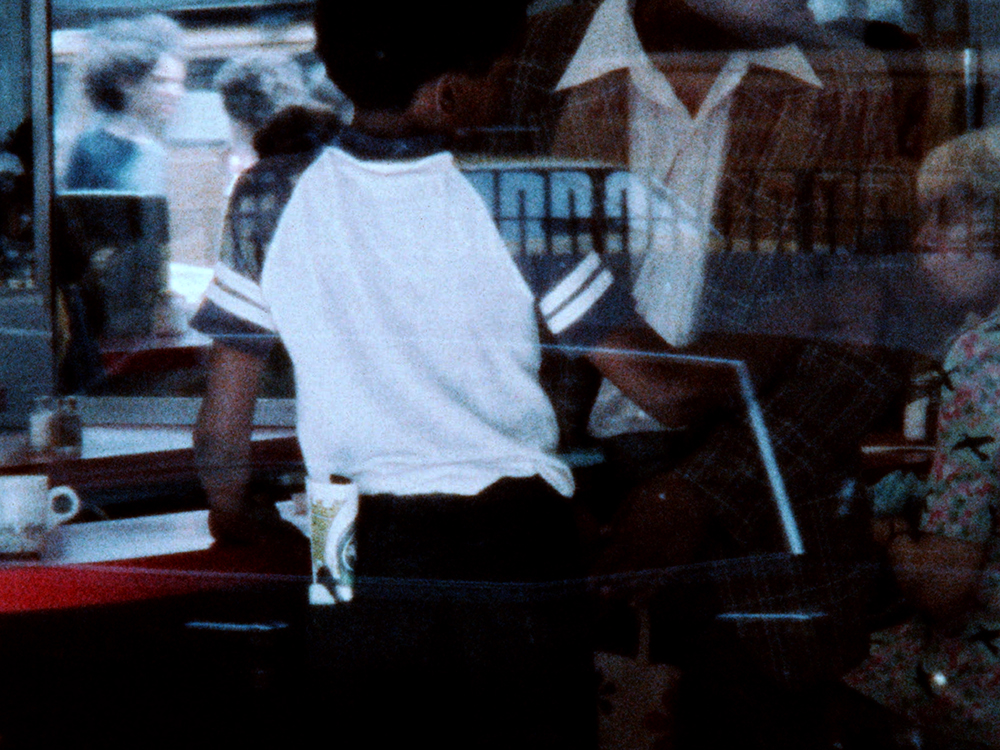
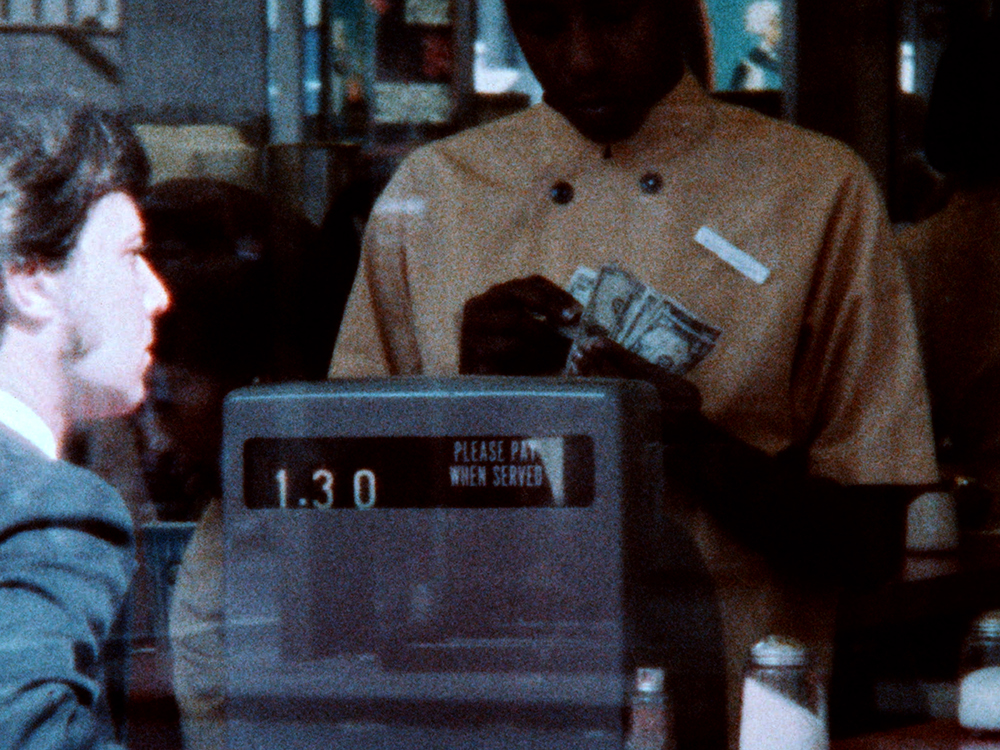
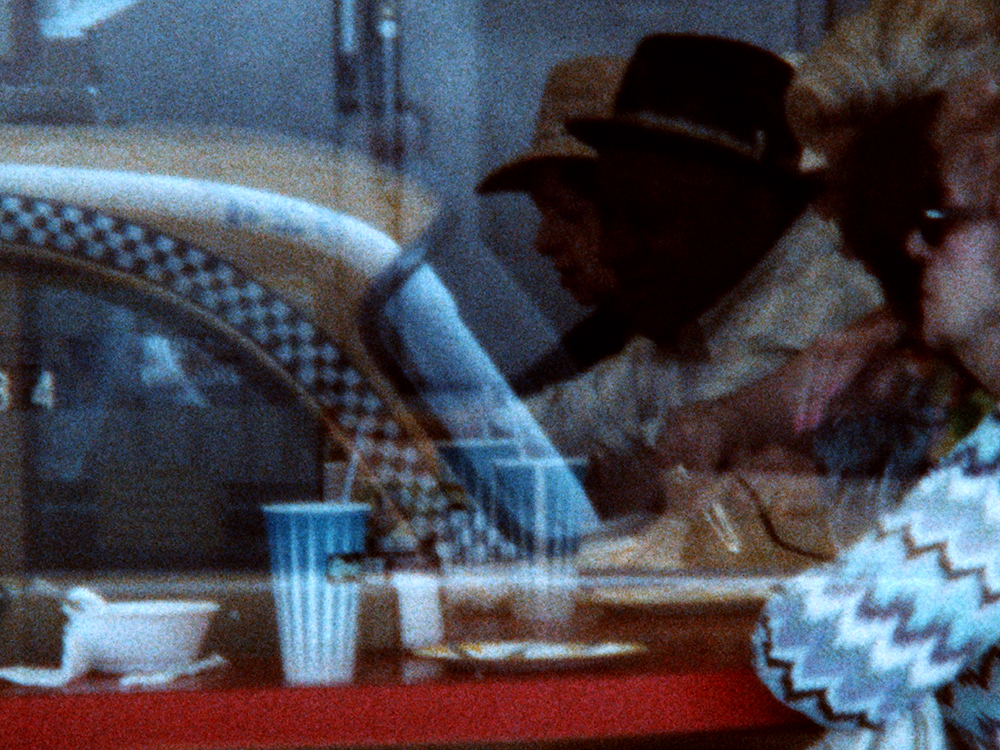
Here I was standing on the same stretch of sidewalk from which Section 1 was filmed, but facing in the opposite direction, looking into a branch of a then-popular coffee shop chain, Chock Full o' Nuts. Every image was taken through the glass windows, which displayed reflections of pedestrians and vehicles on Sixth Avenue. I was especially interested in the transactional nature of what we see, such as payments recorded on the cash register, and the varied movements of people and vehicles as registered in the superimpositions, the clutter of the first section increased by glass. I likely first saw how film superimpositions could be created by window reflections in Stan Brakhage's The Wonder Ring.
5 A store window
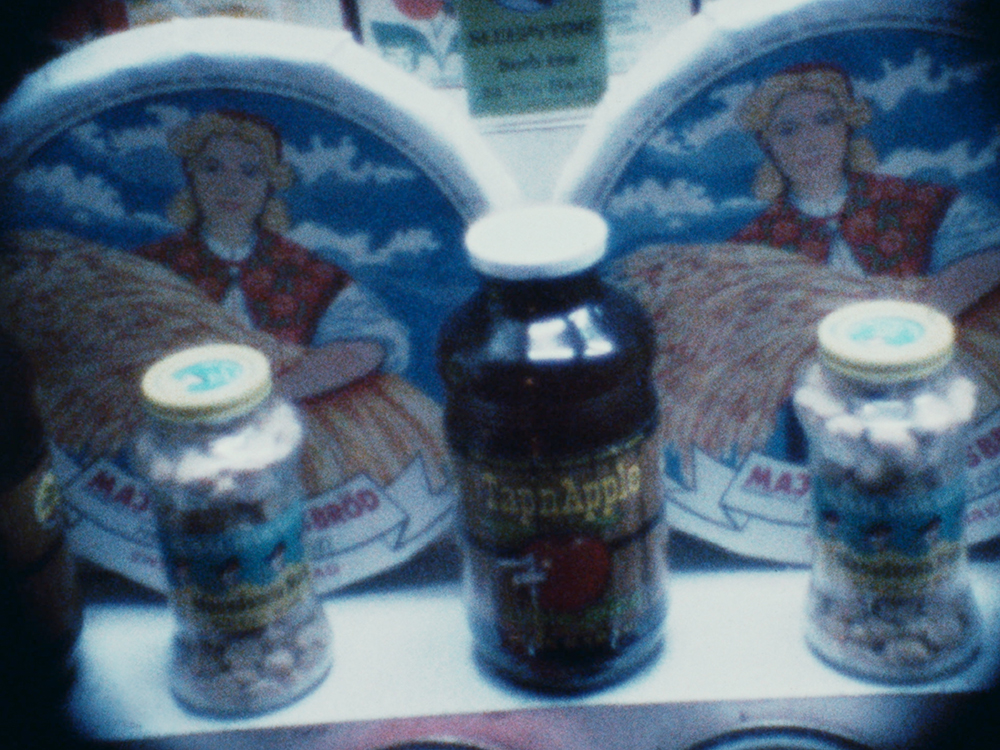
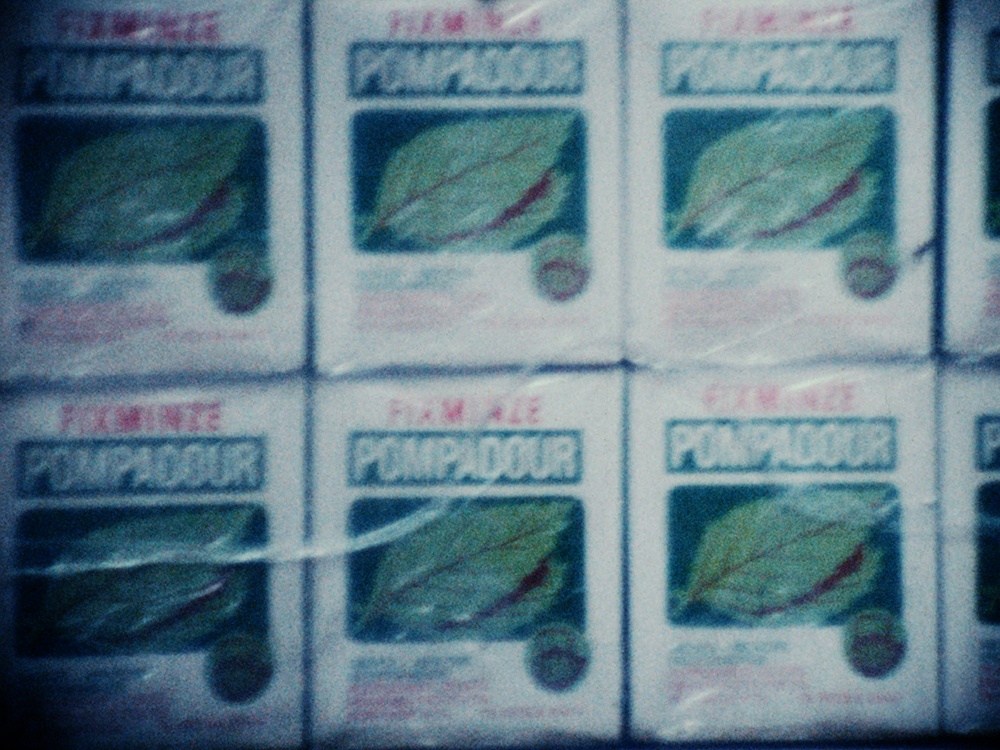
This was the window of a German deli, of the kind that still survived when the neighborhood I lived near (East 80s, close to the East River; I lived a bit north, on East 92nd Street and First Avenue) was still a bit German. Store displays fascinated me, as one of the Section 8 shorts also makes clear. The films of Douglas Sirk indirectly helped me understand such displays as reducing human observers to objects, and this fascination led me to explore suburban shopping malls as well, occasionally renting cars to visit them. The arrangements of store windows interested me for the way they seek to take control of the viewer's perceptions with the same goal of store interior layouts and shopping mall architecture: to reduce the viewer to a consumer. The man's face seen at the end is enmeshed in the products on display. Such designs come close to constructing the viewer as an inadequate being if lacking the objects shown, who can then find completeness by placing money in the pockets of businesses. The viewer of the film will I hope respond with both absorption and independence.
6 PS 1
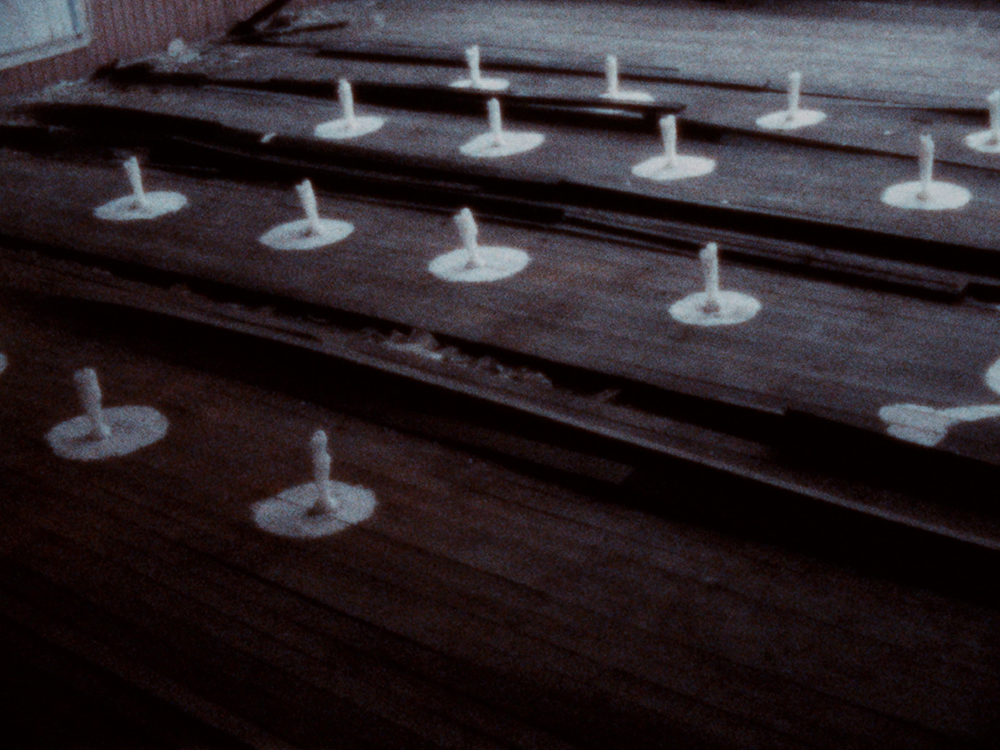
This is the only one of the eight New York City sections not filmed in Manhattan. A former elementary school in Queens was taken over by artists, who mounted this inaugural exhibit, which is still regarded as a kind of landmark in the evolution of new art at the time. I cannot identify the artists of most of the work seen, but the first is by Vito Acconci and the last by Charles Simonds. A very great artist, Gordon Matta-Clark, was also represented, and I remember holes cut in the floors, but I'd never heard of him at the time and didn't fully understand his work. My attitude to what I did film was a bit satiric. Having read screeds by artists about how sculpture should offer an environmental experience rather than static objects, I found rather the opposite in some works present in the show, and a bit of humor in that seemingly reductive aspect of them as well.
7 July 4, 1976, fireworks over New York Harbor as seen from lower Manhattan.
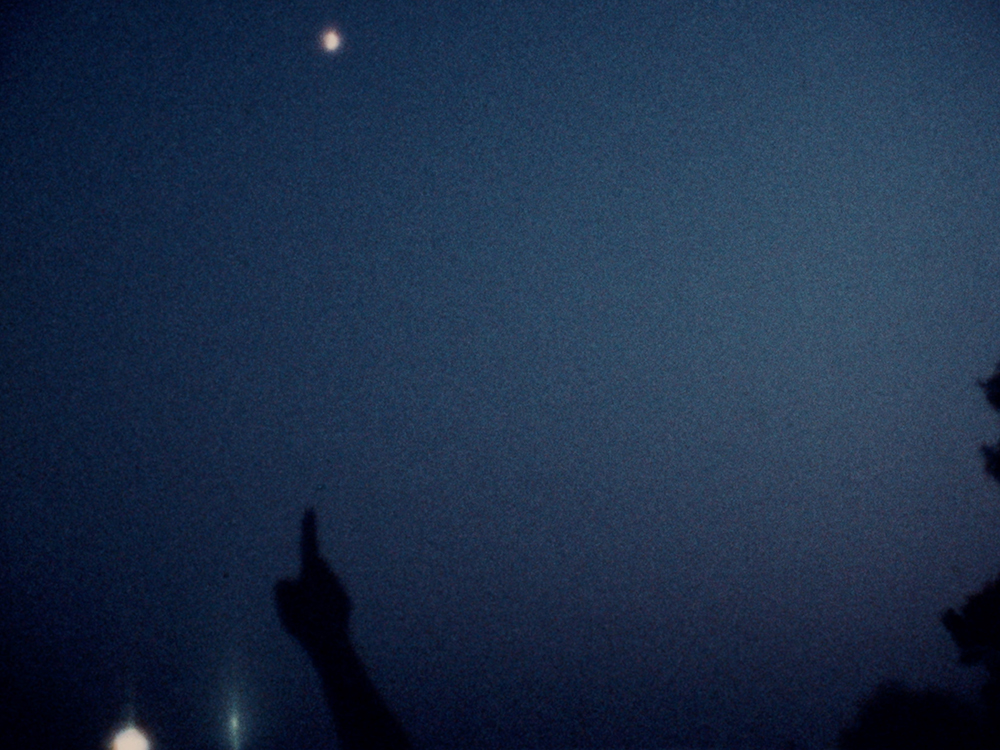
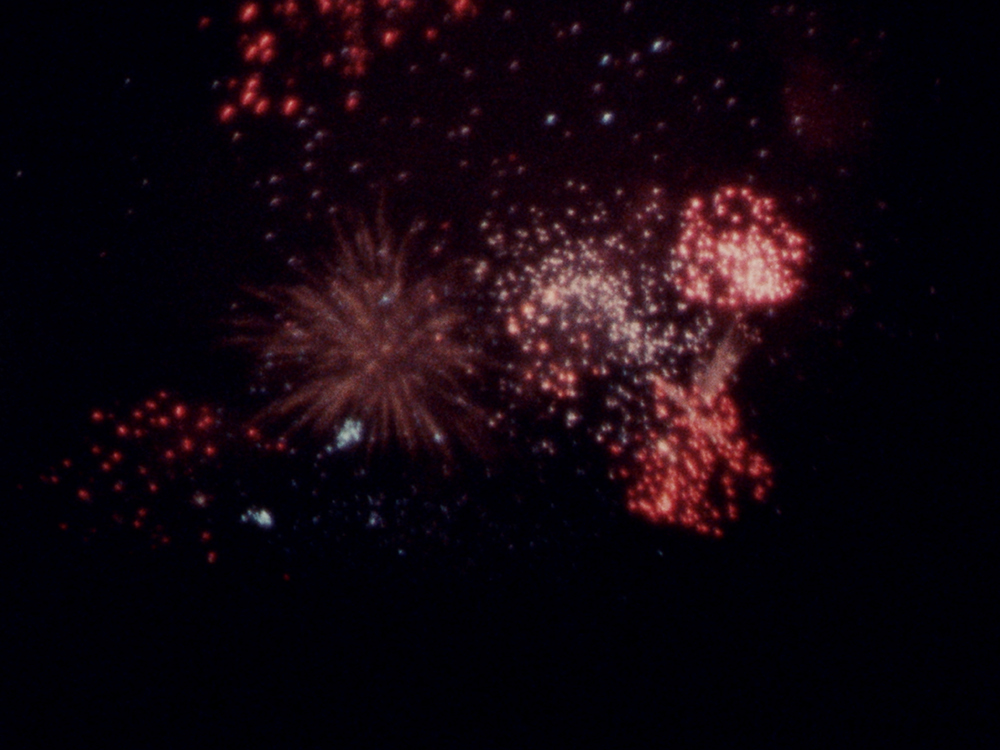
In 1975, New York City was almost bankrupt. In addition, there was a genuine panic. Large corporations had been moving their headquarters out of Manhattan for years; CEOs do like to live closer to their golf courses, and appreciated the lower taxes in states such as Texas, which care far less than "liberal" New York about education, and aid to the poor. The panic affected real estate prices: a five-room apartment on Riverside Drive with views of the Hudson could be purchased for $35,000. The city as a whole did not feel good about itself. Indeed, you could hear people on the street discussing the crisis. The panic had stilled a bit a year later, and to encourage further recovery, the Walt Disney Company offered the city a free fireworks show over the harbor to celebrate the Bicentennial. In addition, tall ships from throughout the world converged on New York as part of the celebration, one of which is glimpsed for a second in the fifth of the 16 "shorts" that comprise section 8. As I went down the stairs of the subway station on East 86th Street on July 4, carrying my camera, I was accompanied by many other New Yorkers entering with the same destination in mind. Not surprisingly, I often had to hold my camera above my head and to film above the crowds. I had never thought I would have any particular admiration for either fireworks or for Disney, but I did then. Psychologically, this event did mark a turning point for the city. At the same time, we should ask, what did we humans do for this event? We filled up the night sky, which has its own beauties, with violent images, pleasingly violent images to be sure, that we created. I was happy to see this, and some other human interventions, just as I am glad to be making films, but I believe we should always take note of the nature of our interventions.
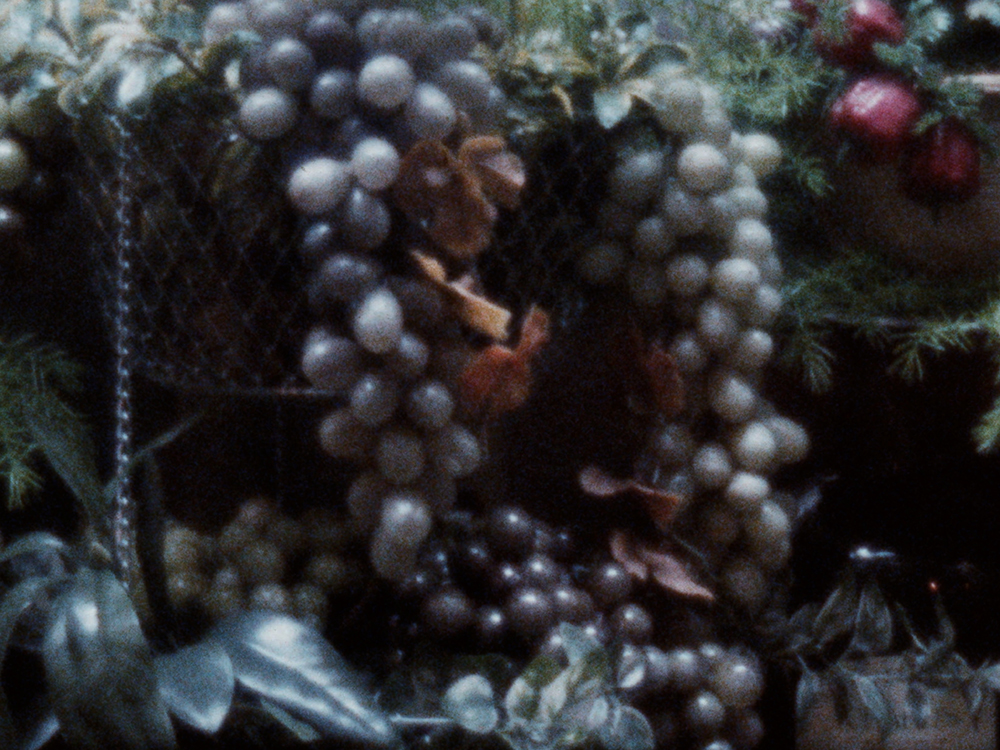
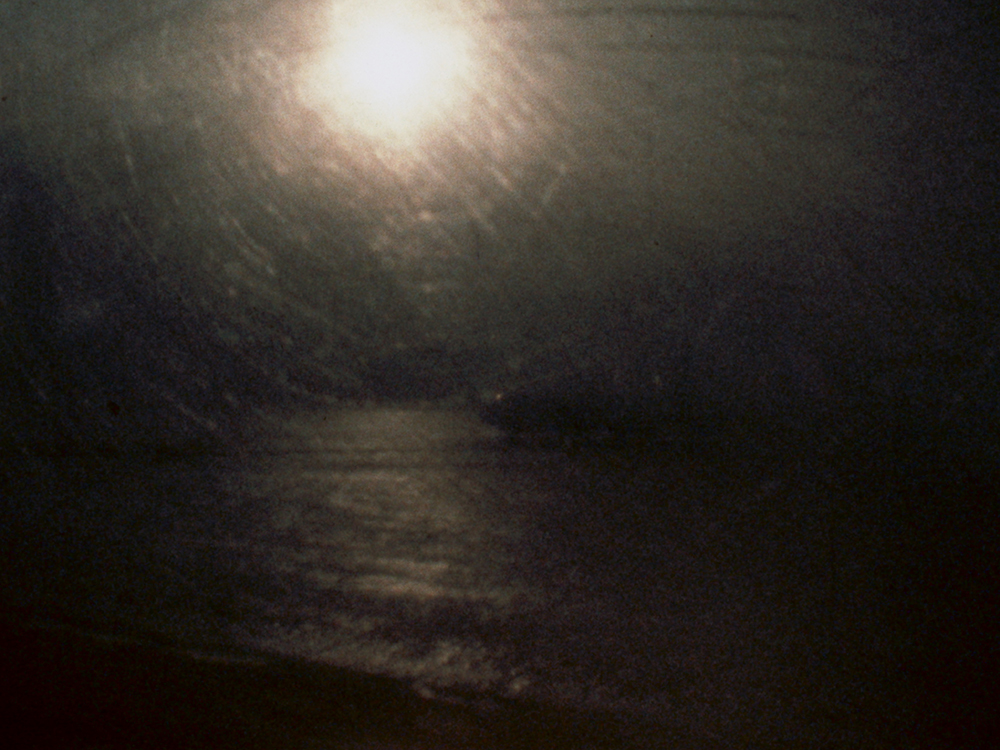
8 Sixteen very short films, each about one minute in length, filmed in a variety of locations, completed over a period of years.
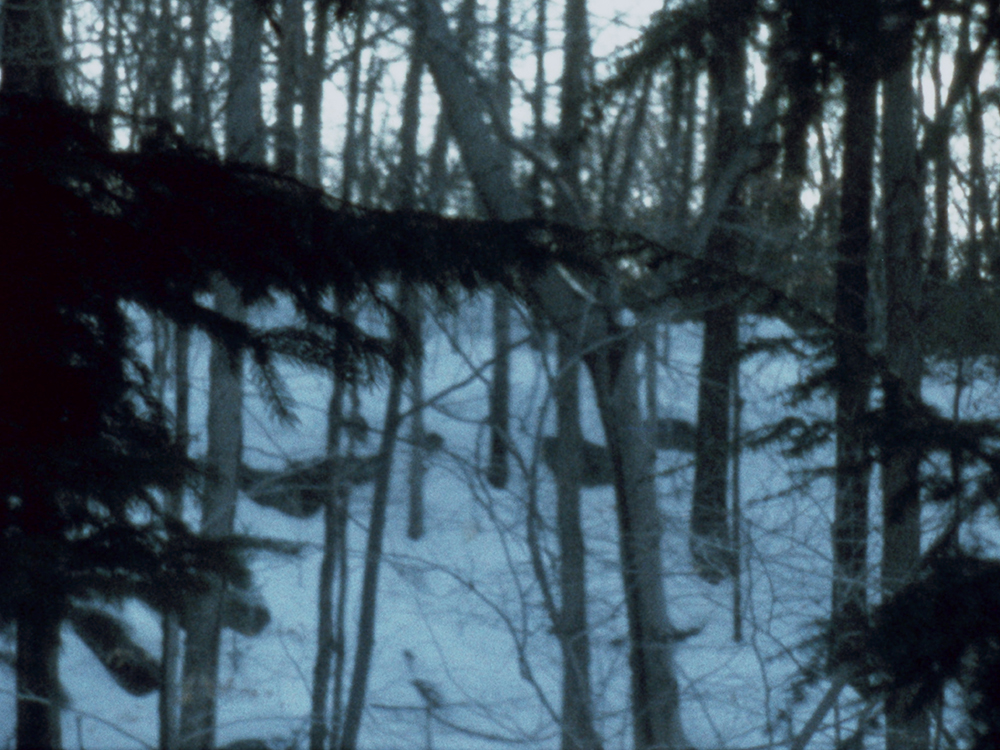
9 The view from the former South Tower
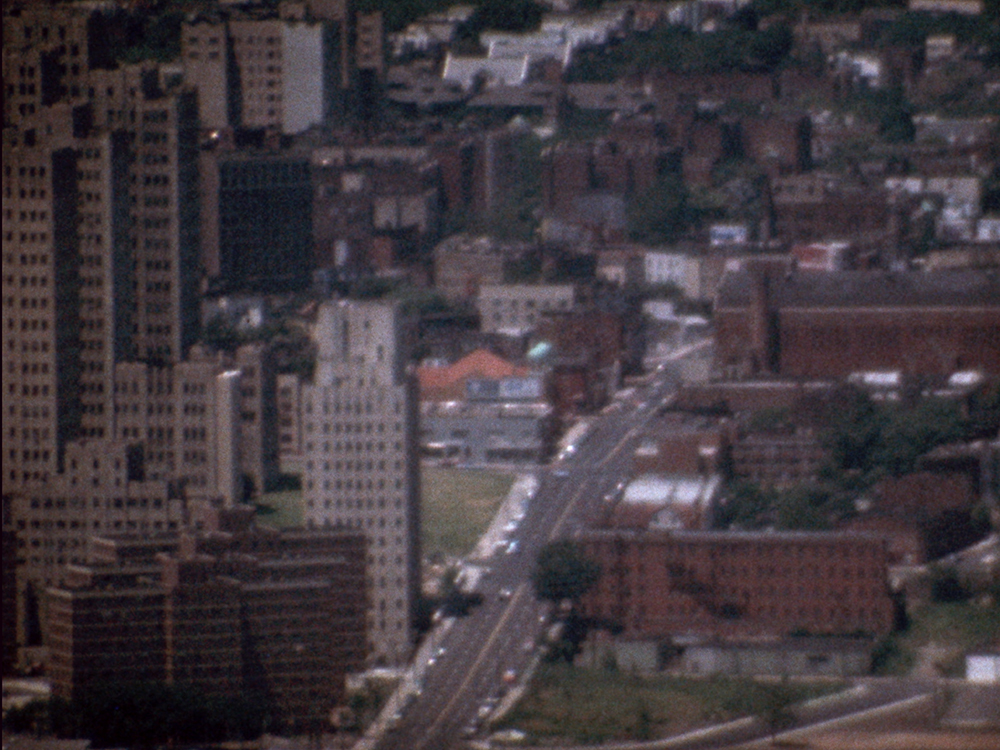
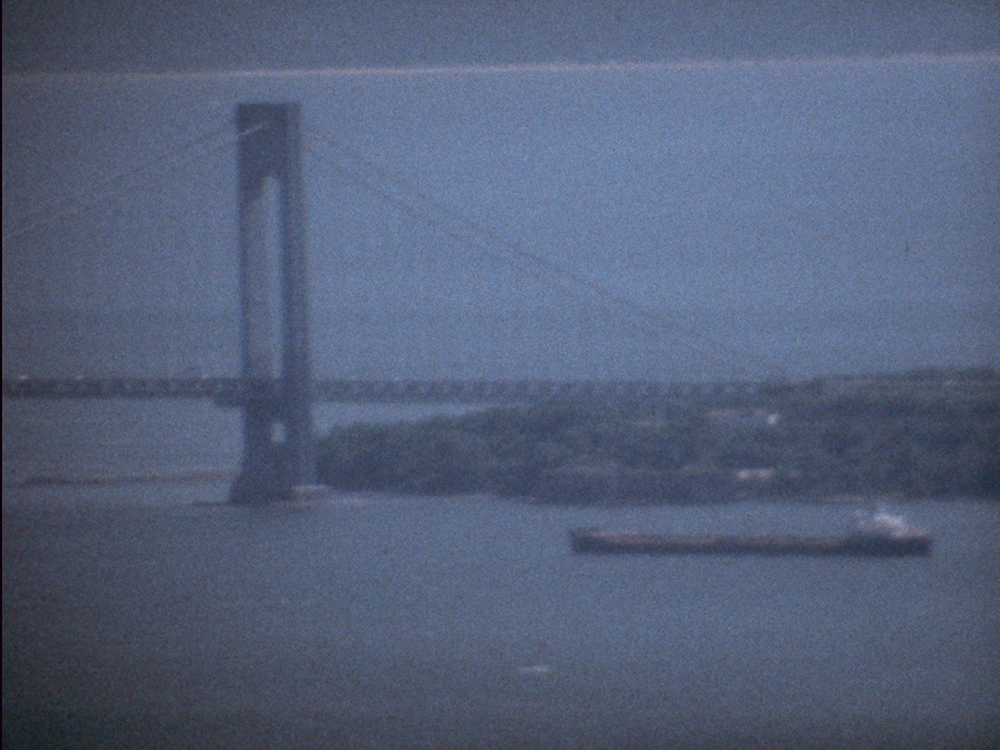
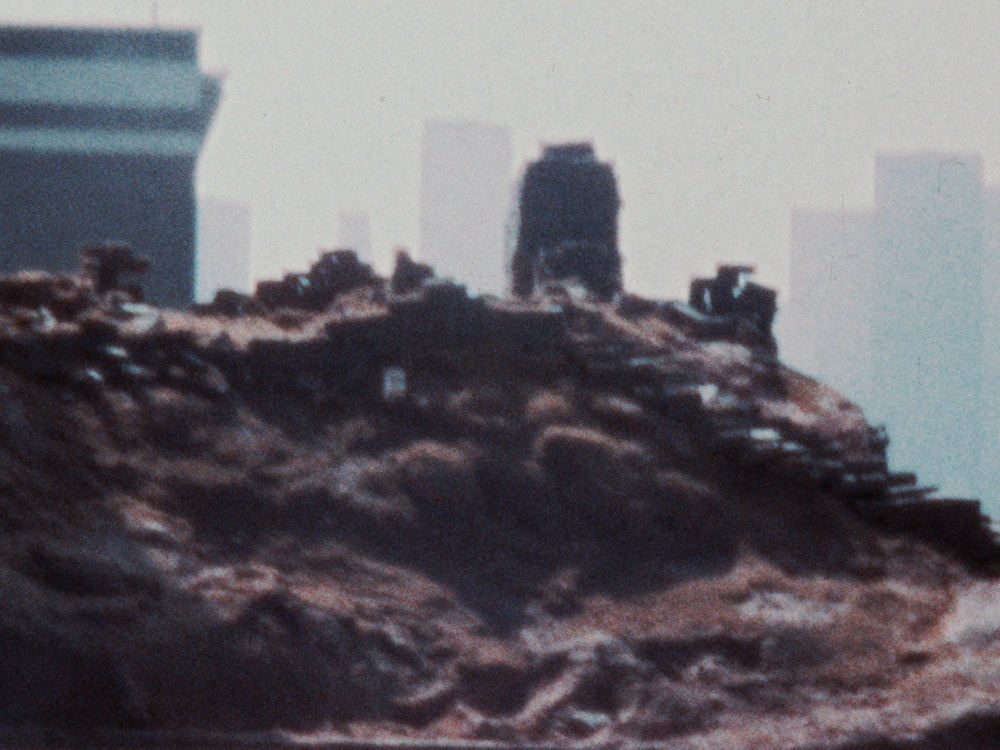
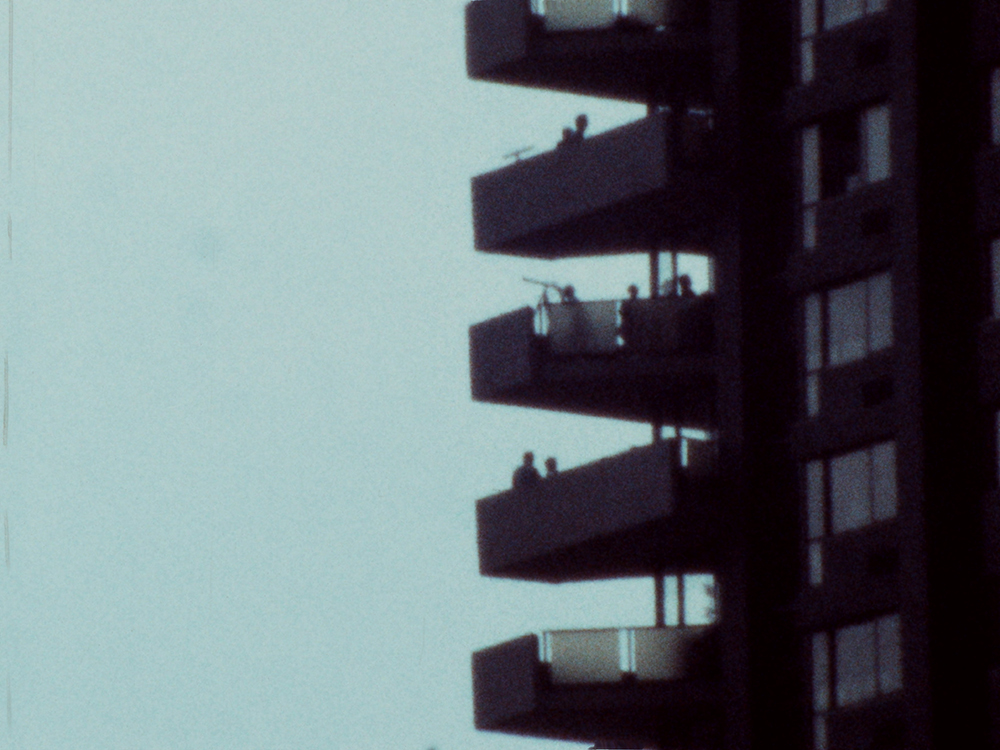
This is the longest section, and one of the few shot on Kodachrome, Kodak's sharpest emulsion, for maximum clarity. This was filmed, after two earlier failed attempts, in one long day in about 1980 from the indoor observation deck on the 107th floor of the South Tower of the former World Trade Center, destroyed along with almost 3,000 lives in the terrorist attacks of September 11, 2001. The two earlier failures were learning experiences. I wanted the best view of the whole region with everything as sharp as possible even at great distances, so I chose the clearest days. But if the winds were low there would be a great deal of atmospheric haze, partly from pollution, not dense enough to be noticeable from the ground over a distance of some blocks but becoming prominent over a few miles. I had first planned to shoot on the outdoor observation deck, rather than through glass from the enclosed one. It turned out that on days with high winds visibility was at its best, and on those days the outdoor deck was closed for safety reasons. Filming from indoors proved to be the right tradeoff, and finally I found such a day and filmed entirely indoors. I believe it was on a Sunday, when pollution was also at its minimum.
To also get maximum visibility at great distances, I left my Angenieux 6-90mm zoom designed for super-8 at home, and borrowed a friend's 12-120mm Angenieux, designed for 16mm but whose C-mount also made it usable in my Beaulieu. Additionally, I brought a monopod, as I think tripods were banned, which increased the stability of the image at very long focal lengths. I also shot at the camera's maximum speed, 80 frames per second, which further reduced shakiness. If you look closely at the vehicles that are visible, they do move slowly, but insofar as there is an unnatural slowed-down effect I think it adds to rather than detracts from the film, suggesting a world that is itself winding down, reductively rendered for viewing rather than to be fully lived.
This section presents my most explicit depiction of the occupation of space, and one proof of that is that many areas that had few buildings at the time of the filming are today greatly altered if not wholly filled. I needed the whole day to shoot, wanting the sun to my back when filming to the west in the morning, and then again looking east in the afternoon, for maximum visibility and color saturation. The stitching together of pans in the editing corresponds to the gradual raising of the camera's tilt to show scenes further and further away, which I hope produces an impression of a carefully designed fabric offering an ever-widening view of the world. Some will recognize both Sandy Hook in New Jersey and Breezy Point in Brooklyn near the end, which taken together define New York's Outer Harbor. Again, beauty and death walk together, here having distant echoes in closeness and distance, as I hope occurs in every section of the film.
10 Television
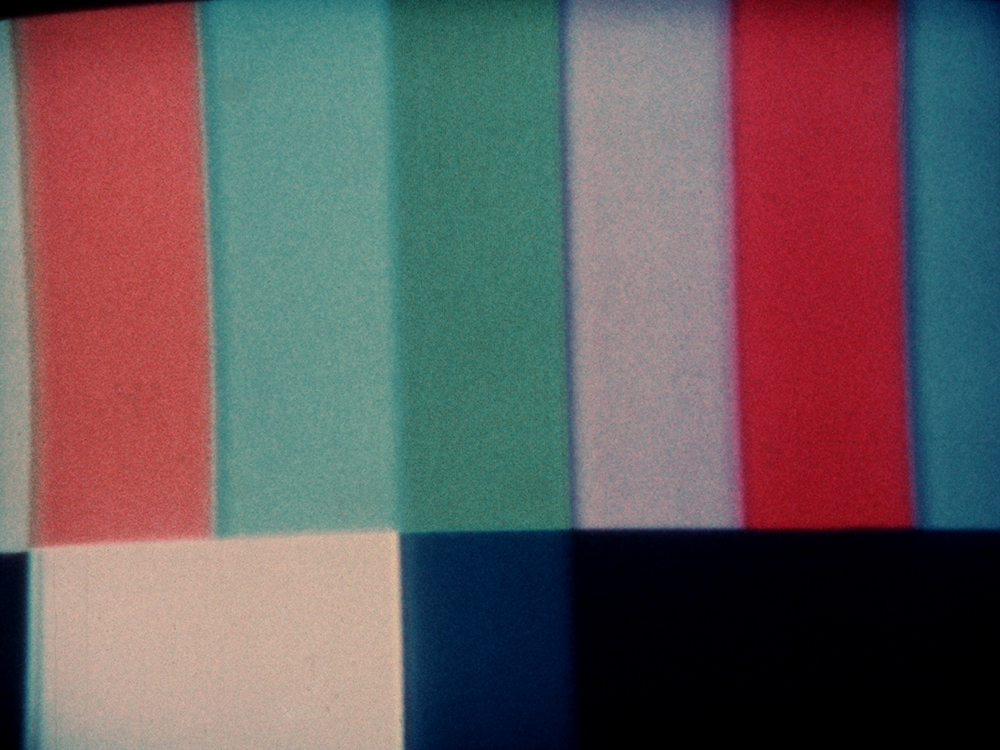
This is the only section filmed on a tripod, from cable TV in 1976 in my New York apartment, and at a very slow filming speed to avoid the shutter-bar effects when filming TV at normal camera speeds. The TV test pattern I chose can be provocatively claimed as a basic rendition of the essence of TV, a kind of television degree zero
. I like the bright colors and tiny movements that are apparent. The seemingly endless sameness with only the smallest of variations together with the TV source could also be seen as constituting an image of dying, or of death. The tiny video movements recall for me the slowing vibrations of Elsie's ball near the beginning of Fritz Lang's M, the last movements of a dying girl. Each of my five earlier 16mm films, begun when I was 19 and restored a few years ago by the Chicago Film Society, also end with what I intended as images of, at least possibly, death. Two are human faces, two are of faceless trees, one of a bright light bulb. Even though I do not pretend to having become in my mature years a "happy camper," it's worth noting that for me none of my recent 4K digital films, made starting three years ago when I was 75, and of which as of this writing there are 50, end with similar suggestions of death.
The effects of my stepfather's suicide were many, each of the three of us closest family members responding differently. For many, and I believe for us, one can not think of a survivor's "recovery" from a suicide, because you never recover, and I would like to think that if more people truly understood that there would be fewer self-obliterations. One effect on me was that I stopped bicycling. For a decade, since turning 18, in the Boston area and then in New York City, I bicycled as my main mode of transportation, and this included a trip from New York to Boston. I find bicycling to be intensely pleasurable, in the almost weightless balance, the sensations of motion, the feeling that your own effort produced the travel that results and thus every image you see. It is also an excellent practical solution to city travel, and longer distance trips can be great too. It is ecologically almost perfect. In uniting effort and its result, it has the power to make one feel, amid all of the separations that our industrial culture forces on us, whole again. In the days after the suicide, however, I no longer felt those pleasures. I suspect that mostly subconsciously I had the notion that I did not deserve them. My body felt empty, almost as if it had been transmuted from flesh and muscle and nerves and bone into cardboard. The pleasures of pedaling, and of feeling whole, drained from my life. My limbs were almost dead. Smaller echoes of such feelings can be found in moments in which crowds obliterate themselves, the living room seems like a tomb, lawn chairs feel like monsters, a store window becomes a prison, art feels lifeless and dead, the cityscape gives a sensation not of the endless variety which it surely does possess, but of deadening closure. When something on my bike broke that I thought I could not fix myself, I just stopped, and the nature of the views offered in Suicide Note may partially result from my switch a year before I began work on the film to the greater passivity of views from public transit. Almost two decades later, when I had finally started again on a different bike, a bike shop could find no particular problems with the bicycle that I had thought had become unusable.
This film, which was made between 1976 and 1984, had its first public screening ever on April 9, 2002, at the Robert Beck Memorial Cinema in Manhattan. More information on that specific public screening can be found below. There was a second public screening, at which seven people saw it to the end, at Caro d'Offay Gallery in conjunction with my one-person art exhibit, on August 1, 2008, and a third, presented by White Light Cinema, on April 16, 2011.
This film actually began with the title, unlike my earlier films which began with ideas of imagery. Its conception came about a year after my stepfather's suicide, accomplished by his jump from the 15th floor window of his and my mother's apartment on the Saturday of Memorial Day Weekend, 1975. Like the majority of suicides, he did not leave a note. My idea for the film was that it would be the note he didn't leave, and it would be my own if I ever did the deed which I was not then considering, and it would also be the "suicide note" for our culture, so much of which seemed, and seems, headed toward death, or in the immortal words of Christopher MacLaine's great film The End, "the grand suicide of the human race." However, I immediately realized that I could not use this title while working on it, lest my friends, and my sister, worry for me. It was always intended to be the title for public release, and now that the Chicago Film Society is restoring it and public shows seem likely, I am revealing the title, previously only known to a few close friends. Indeed, for some forty years I have been lying when asked what "SN" stands for; I always said it didn't stand for anything. Interesting, once I started writing the title, I realized that keeping it secret was perhaps primarily a way of protecting myself; simply typing or stating the words is disturbing. Today I would suggest to anyone referring to the film in speaking or in writing to use the full title first, and then, especially if you prefer, "SN" in subsequent iterations of it.
Patrick Friel has written some comments on SN in conjunction with his showing of it in Chicago: As a complement to his current show at Caro d'Offay Gallery (which has been extended a day to August 2), local film and art writer and artist Fred Camper screens his legendary (in some circles) nearly-unseen (this is only its second public screening ever) silent Super-8mm film SN (1976-84). Comprised of ten sections, one of which consists of three short reels randomly selected from a possible sixteen, Camper's film is an unsettling, hermetic work that continually pushes in on itself, a "closing down" of options (as Camper puts it) that force the viewer to consider the formal elements of the film: editing rhythm, camera movement, and, most importantly, the tension created by changing spatial configurations and the play between depth and shallowness in the image, both within each section and among the individual sections. A striking example comes late, in the longest reel: as Camper pans across the New York City skyline from different buildings the initial depth one sees collapses and flattens, becoming a near-blur and forcing attention away from the "subject" to the flatness of the screen itself. It is an encapsulation of the kind of re-focusing and re-seeing that Camper is attempting to engage his audience in throughout. In this respect, it shares a similar agenda as his current art making. SN is not an easy film and perhaps not one for the casual viewer but, even if one does not understand it completely, there are magical moments and rewards for those willing to really look. (1976-84, 105 min, Super-8mm). Camper will also be giving a just-scheduled gallery talk at 4pm on Saturday, the final day of his exhibition.
Here's the description written for that screening by Beck founder and co-curator Brian Frye:
Finally, the RBMC hosts the world premiere of Fred Camper's rumored, fragmentary, experimental feature film, SN. Made between 1976 and 1984, SN consists entirely of Super-8mm film, the dulcet tones of old Ektachrome reversal resplendent in their silent beauty. The film as extant consists of ten sections, one selected at random from a larger pool of similar possibilities. Most focus on the architecture and urban space of New York City to varying degrees, employing different shooting styles. The perfect film for the perfect critic, SN is slightly, subtly different every time it is viewed. Something like a bittersweet, twelve-tone love-song for the cinema and the greatest city in the world alike, SN should not be missed — not only is it a beautiful film, but it may not be possible to see it again for a good long time. Mr. Camper himself will be on hand to introduce and discuss the film. [Brian was right about "a good long time." There were two more public screenings, as documented above, and then none for the next fifteen years. Since I was screening mostly edited original, each screening might have resulted in irreparable damage, and the screenings were far from perfect due to splice marks and other issues; the splice marks have been removed in the restoration.]
Many of the sections of this film are edited original (in other words, I have no other copy), so I don't screen it often, nor are any other public screenings planned presently. (One question I will not answer: whether the title means, or stands for, anything.)
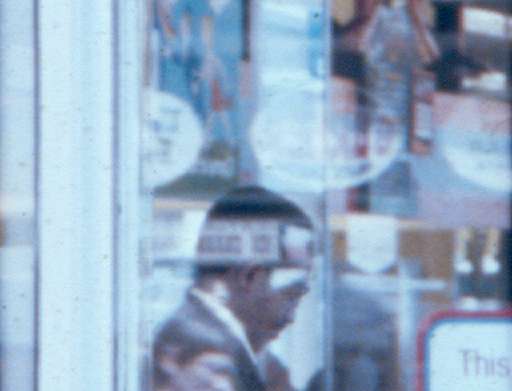
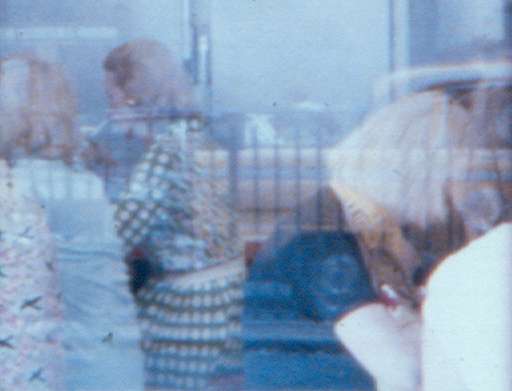
Two frame enlargements of adjacent shots in the fourth section of SN, a film by Fred Camper.
Most of the film was shot in Manhattan, before I moved to Chicago in August of 1976 and on return trips there afterwards. There is no "narrative." The footage is unmanipulated, in the sense that there's no optical printing, no in-camera superimpositions, and most images are in focus. None are "directed," in the sense that when people are visible, I didn't tell them what to do. Each section except the eighth is set in a single location; each reel of the eighth is also set in a single location. Most of the sections are either devoid of humans, or have figures seen in public places. I generally try not to give any clues as to what SN is "about," preferring not to bias viewers in any direction. Only after a screening do I pass out a list of each section and its location.
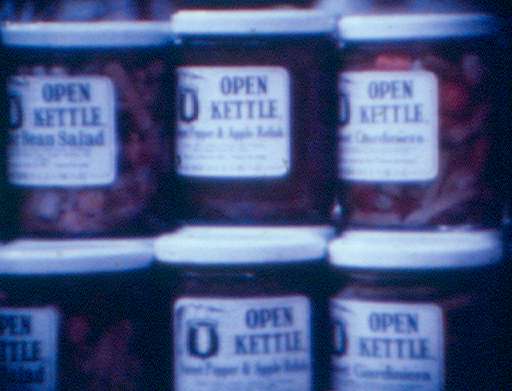
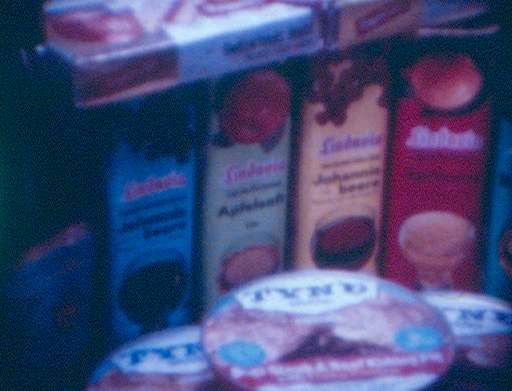
Two frame enlargements from the fifth section of SN, a film by Fred Camper.
The left image is the very first shot of the section.
My original plan was for something much larger than what now exists. I wanted to have 18 sections in all. About a third of them were to have sound, and I did record sound for some of the footage I shot, though no section now included was meant to have sound. But more, each projected reel was to have been selected, through simple chance operations, from a much larger number of edited reels, usually but not always 18. For example, the first section in the film as it now exists consists of people walking through Herald Square. In the original plan, this would have been the second rather than the first section, and the reel that I'm now showing would have been one of 18 reels, any one of which would have had an equal chance of being chosen as the second section on any particular screening; none of these reels would have ever been anything other than the second, though. Two of those other possible reels were to have consisted of the same footage that I'm now showing, but edited very differently. The other fifteen reels would have had different footage, most but not all also of people on city streets. To create these reels, I would have shot footage in five different locations, and then produced three different "edits" of the same footage from each location. So on each screening, there would have been only a one in six chance of seeing the same location as was seen at the previous screening, and only a one in eighteen chance of seeing exactly the same reel. Part of the idea was to have a film that was very different in various ways, but similar in others, on each screening, engaging issues of memory, of geography, of mental labyrinths. It was also partly about the kind of cinephilia that dictates multiple viewings of a film one loves, in which one notices how the same film changes; this was to have been, in a more literal sense than usual, a film to be seen many times.
Completing all of this would have required becoming wealthy, purchasing expensive optical printing equipment, and working on it full time for maybe twenty years. My fantasies of becoming wealthy, together with several other factors, instead led me into ten years of serious depression and the brink of personal ruin, after which, around 1994, I had to abandon this dream, surrender any hope of completing it according to the original plan, and concentrate on making a living, which is what I have been doing. There is enough footage for single "substitution" sections for each that now exists, and for expanding the ten sections to twelve, so a version with a little bit more of the planned chance effect is at least a distant possibility.
One small part of the original aleatory plan survives even in the version that I'm showing. The eighth section, the one on three reels, is always selected by simple chance from among sixteen very short reels in all. Each time it's screened three reels are selected from the sixteen, and their order is also determined by chance. I used to accomplish this via coin flipping; four flips in a row generate a number between 1 and 16. But recently I've been using one of several Web sites that offer truly random numbers; the one I use generates numbers within a specified range using atmospheric noise — a truly random, and nature-based, process.
The original plan also would have involved A&B roll printing of every section, to hide the splices. Instead what I have are reels of edited original and edited workprint. I had long considered that fact a reason never to show the film in public, though I have screened it privately over the years, as a result of which a number of people (about 100) have seen it. It has received what might be called "mixed reviews." I still believe in it, or I wouldn't show it at all, and aside from the visibility of the splices (and the fact that some of the workprinting is not of the best quality, and the colors of the workprint in at least one section have noticeably faded), I do consider it a completed film.
Here's the story of how the Robert Beck screening came to happen:
It is the remarkable spirit and ethos of the Robert Beck, the loose but not careless, open but loving, ambience that it has established over the years, through the unremunerated dedication of Brian Frye and Bradley Eros, that made me think of it as perhaps the one place where I would feel comfortable about showing SN publicly. But I really only began to think of this after Brian Frye asked to see it, and liked it, and later he asked me to show it, but at a different venue than the Beck. It was easy to answer no immediately then, almost out of reflex, but his request did start me thinking about showing it at the Beck. He is, after all, the first "curator" who asked to see it and then asked to show it. And there are several other reasons as well.
The Beck is one of the few places I've ever attended where 8mm actually looks good, due to its uniquely shallow space but screen that's high enough to be visible, and due to the loving care of the filmmaker-projectionists Bradley and Brian. This will be in fact the first time that I've really been able to see the film, because it will be the first time that someone other than myself projects it.
One small problem that Brian's request posed to me is that I never want to permit even the appearance of conflicts of interest involving my work as a writer. Brian is a filmmaker whose films I like a lot, have written on, and hope to write on again. So while his request is what got me thinking, it was important to me that the decision not be made by him. I brought a few sections to New York to show Bradley Eros some months back, he viewed them, and then said he'd like to show the whole thing.
One last factor in my agreeing to a public showing now is that my faith in my original "model," based in part on the life of Gerard Manley Hopkins, by which I held that it didn't matter if people didn't see or appreciate my work in my lifetime, as long as it survived to be discovered eventually if anyone wanted to, has been totally undermined by "vinegar syndrome." It turns out that what we all thought was durable "safety film," which was not supposed to decompose as fast as nitrate, may be even more unstable, and could easily turn to unprojectable mush in mere decades. The footage for this film is already 20 or 25 years old. If people want to see it, the next few decades may be their only chance.