Artist's Statement on Quarries
Artist's Statement on Quarries
Selected Works:
All Works:
Index to and links to all the "Quarries" works in Quarry 1: Times Square completed thus far
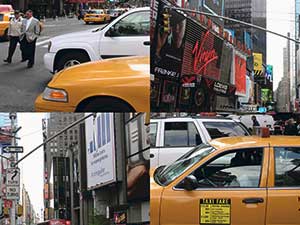
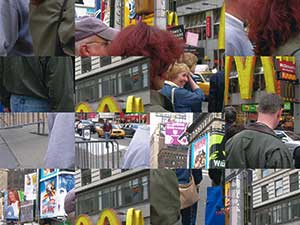
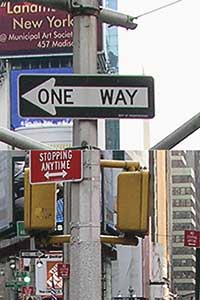
Original images for Quarry 1: Times Square 1, Quarry 1: Times Square 2, Quarry 1: Times Square 3, and Quarry 1: Times Square 4.
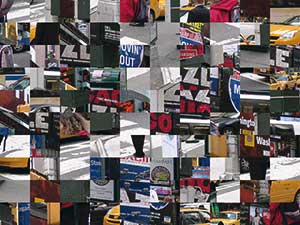
This first group of Quarry works is based on photographs I took in May, 2005, in Times Square, New York, New York. To construct each of the Grids, a single image is divided into between 4 and 169 parts, and these parts are then rearranged using random processes. My use of randomness here is different. I believe, than in much other art. It is my hope that because of the choice of images and the ways the parts are rearranged and presented, each work creates a kind of opening-out effect, suggesting to the viewer that seeing, and the seeing of a single image, offer a nearly infinite diversity of possibilities. More can be found on the Quarries main page and in my Artist's Statement.
Scroll through 36 selected "Grids" works from Quarry 1: Times Square
Scroll through 45 selected "Twos" works from Quarry 1: Times Square
Scroll through all 33 "Quarries" works of Quarry 1: Times Square completed thus far
Scroll through all 144 "Grids" works of Quarry 1: Times Square completed thus far
Scroll through all 10 "Recuts" works of Quarry 1: Times Square 1 completed thus far
Scroll through all 81 "Partials" works of Quarry 1: Times Square 1 completed thus far
Scroll through all 64 "Partials" works of Quarry 1: Times Square 2 completed thus far
Scroll through all 189 "Twos" works of Quarry 1: Times Square
Quarry 1: Times Square 1, 12G, 1
Quarry 1: Times Square 2, 12G, 1
Quarry 1: Times Square 3, 12G, 1
Quarry 1: Times Square 4, 12G, 1
Scroll through all 4 of the "Quarries, Figmented" works Quarry 1: Times Square completed thus far
Quarry 1: Times Square 1, Remade 6.1
Quarry 1: Times Square 1, Remade 13.1
Quarry 1: Times Square 2, Remade 10.1
Quarry 1: Times Square 4, Remade 10.1
Quarry 1: Times Square 4, Remade 12.1
Quarry 1: Times Square 1, Enlargements 9.1
Quarry 1: Times Square 2, Enlargements 8.1
Quarry 1: Times Square 4, X-Ray 9.1
Index to and links to all the "Grids" works in Quarry 1: Times Square completed thus far
Index to and links to all the "Partials" works in Quarry 1: Times Square completed thus far
Index to and links to all the "Twos" works in Quarry 1: Times Square
Index to and links to all the "Figmented" works in Quarry 1: Times Square completed thus far
For one group, the Quarries, Figmented, I divided the original image into grids between four by four and thirteen by thirteen, and then puts each cell in the grid through a treatment related to that used in Figments works, creating 35 lower resolution versions of each of the 36 cells, and then using random numbers to decide which of those along with the original cell to use. Each work has nine differently-modified versions of the original image. The Remades are constructed by rearranging the cells of the original image into new patterns in the smaller sheet; in the larger sheet, the rearranged image is repeated nien times in the manner of the Figmented works.Be sure to click on the larger version and move around in your browser to compare different treatments of the same image.
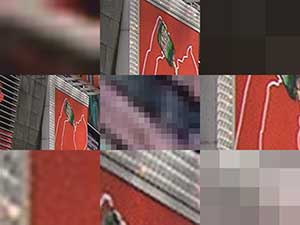
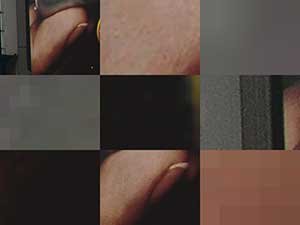

For the Enlargements, I divide an image into a grid, and then repeat each cell nine times in three by three arrays, but with the original cell appearing only once; the other eight are ever smaller details of the original cell. For the Partials, I juxtapose one of the original cells in an Enlargements with the eight details, carefully arranging them.
As I work on these Times Square images, the "Quarries" treatments seem especially appropriate, underlining the multiple divisions between objects and areas within the urban landscape, as well as the arbitrariness of the arrangement of parts in a space such as Times Square. I hope, too, that the power of signs and logos is somewhat diffused by these rearrangements. One viewer commented on these that the fragmentation gives a better sense of the place than whole images would. So far I have made works in this group based on four different images ("Times Square 1," "Times Square 2," and so on), but eventually I'm planning to use more.

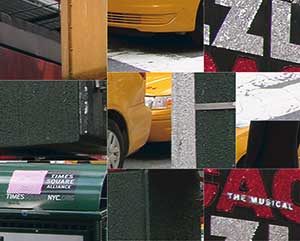
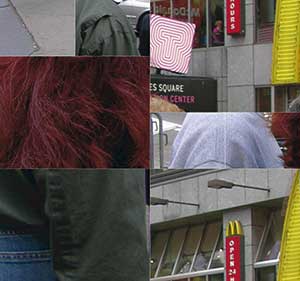
The Twos are constructed without the use of random numbers. I select cells from the Grids from eight by eight to thirteen by thirteen and juxtapose them with the smallest possible white band between, looking for connections and disconnections, logic and paradox. They will be limited to 63 per image, each an edition of one, so for the first three images used all the Twos have been constructed. The Quarries sheets also use cells from the Grids, from three by three to thirteen by thirteen, using random numbers to order them and then using my subjective judgment to decide on the best "architecture" for the sequence of cells.
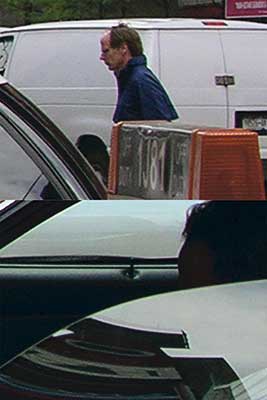
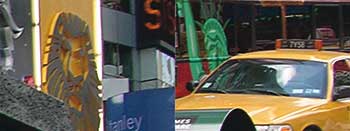
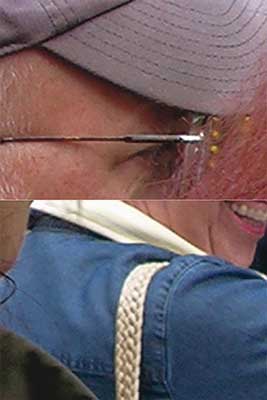
The sizing of the Twos and Quarries is proportional to the sizes these cells have in the original Grids sheets. Thus the sizes of the Quarries sheets decreases as the number of images increases. In the Web versions, I have settled on a fixed enlargement, so that the sizes of the Twos and Quarries on screen are proportional to their actual sizes; on some screens, screen size and actual size may be close. In the viewing the first few Quarries, you may find the image larger than screen size; if you change the final "html" to "jpg" in the address bar and have your browser set to resize images to fill screen (in Firefox, type about:config in the address bar and click on "browser.enable_automatic_image_resizing" to change it from "false" to "true") you will see the whole image at once.
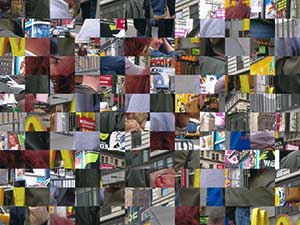
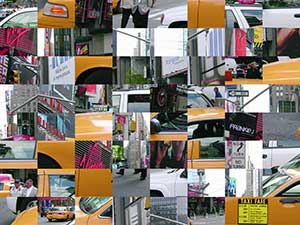
The works now titled Remade were titled Figmented-G before November 23, 2010. Quarry 1: Times Square 1, Remade 6.1 was Quarry 1: Times Square 1, Figmented-G 6.1; Quarry 1: Times Square 1, Remade 13.1 was Quarry 1: Times Square 1, Figmented-G 13.1; Quarry 1: Times Square 4, Remade 10.1 was Quarry 1: Times Square 4, Figmented-G 10.1; Quarry 1: Times Square 4, Remade 12.1 was Quarry 1: Times Square 4, Figmented-G 12.1.